


TYPO3 v14 Upgrade Guide 2026: Update, Upgrade, or Relaunch?
Upgrading TYPO3 should be treated as a strategic project that affects security, performance, editor workflows, maintainability, and the long-term stability of the website. A well-planned TYPO3 upgrade helps organisations stay within supported TYPO3 and PHP versions while reducing security risks and technical debt.
This guide provides agencies, enterprises, and public-sector organisations with a clear, vendor-neutral framework for deciding when to upgrade, when a relaunch makes more sense, and how to plan a safe migration to the latest TYPO3 v14 LTS release.
Who This TYPO3 Upgrade Guide Is For
This TYPO3 Upgrade Guide is intended for organisations already using TYPO3 that need a structured approach for planning upgrades, reducing technical risks, and maintaining long-term supportability. It is especially relevant for teams balancing security, compliance, performance, and budget requirements at the same time.
Main audiences
- Agencies managing multiple TYPO3 installations across different TYPO3 and PHP versions for their clients.
- Companies and enterprises using TYPO3 for corporate websites, e-commerce platforms, portals, or intranet solutions.
- Public-sector and government organisations that must consider accessibility standards such as WCAG/BITV, GDPR requirements, and long-term maintenance planning during upgrades.
What you will learn
This guide explains:
- The difference between TYPO3 updates, major LTS upgrades, and full relaunch projects,
- How to analyse your existing TYPO3 installation and identify upgrade risks early,
- How to estimate upgrade effort realistically based on TYPO3 extensions, custom code, and integrations,
- How to plan a structured TYPO3 v14 upgrade process including testing, QA, go-live, and rollback preparation,
- And when a relaunch is more cost-effective than upgrading multiple legacy TYPO3 versions.
What Is a TYPO3 Update, Upgrade, or Relaunch?
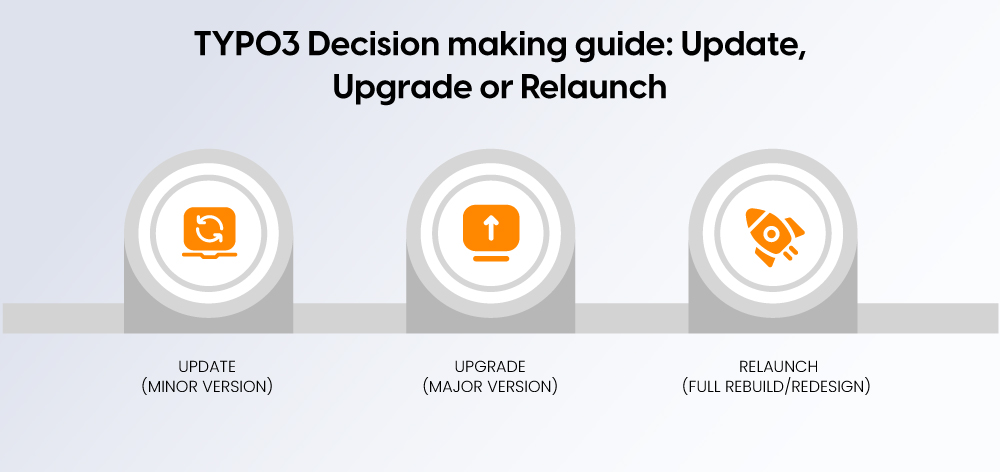
Before planning budgets and timelines, it is important to distinguish between a TYPO3 update, a major TYPO3 upgrade, and a full relaunch. Each option has different technical implications, risks, costs, and long-term benefits for your TYPO3 project.
TYPO3 Update vs Upgrade vs Relaunch
A TYPO3 update usually refers to a minor or security update within the same LTS branch, for example upgrading from TYPO3 14.1 to 14.3. These updates mainly focus on bug fixes, security patches, and stability improvements.
A TYPO3 upgrade moves a project from one major LTS version to another, for example from TYPO3 v11 LTS to TYPO3 v14 LTS. This typically involves changes to the TYPO3 core, extensions, TYPO3 templates, Composer dependencies, PHP compatibility, and custom code.
A TYPO3 relaunch goes beyond the technical platform and includes a redesign of the website structure, frontend UX/UI, content strategy, accessibility, and overall digital experience.
Overview: TYPO3 Update vs Upgrade vs Relaunch
Aspect | Minor Security Update | Major LTS Upgrade | Relaunch |
Typical scope | Core patches and small fixes | Core, extensions, templates, Composer setup, configuration | New design, content structure, UX/UI, and technical platform |
Version change | Within same LTS branch (e.g. 14.1 → 14.3) | Between LTS versions (e.g. v11 → v14) | Often includes upgrade plus complete rebuild |
Main goal | Security and stability | Long-term support, compatibility, new features | Modernise user experience and technology together |
Impact on editors | Minimal | Moderate backend and workflow changes | Completely new workflows and editing experience |
Typical risk level | Low (with tested backups) | Medium, depending on custom code and extensions | High, as the entire platform changes |
TYPO3 Versions at a Glance
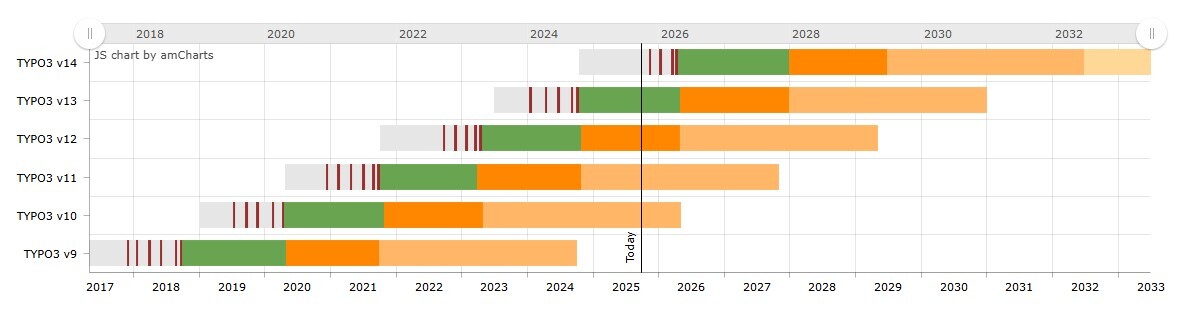
A successful TYPO3 upgrade project starts with understanding which TYPO3 LTS version your website is currently running and how long that version will continue to receive support. This helps organisations decide whether an upgrade is urgent, whether ELTS can temporarily bridge the gap, or whether a larger relaunch project should be planned instead.
Current TYPO3 LTS Status
TYPO3 v14 LTS (14.3) is the current long-term support release and the recommended target version for new TYPO3 projects and upgrades from older LTS versions.
TYPO3 LTS releases typically include:
- Regular bug fixes and maintenance updates,
- Long-term security support,
- Predictable upgrade paths between major versions,
- And optional Extended Long-Term Support (ELTS) after the official support period ends.
This structured release cycle makes TYPO3 particularly suitable for enterprise, government, and long-term digital platforms.
What LTS Means in Practice
In practical terms, TYPO3 LTS releases provide:
- Regular security patches and bug fixes within the same LTS branch,
- Clearly defined maintenance and security support timelines published in the official TYPO3 roadmap,
- Stable planning cycles for agencies and organisations managing multiple TYPO3 installations,
- And improved compatibility with supported PHP and infrastructure versions over several years.
TYPO3 v14 Release Cycle
TYPO3 v14 followed the standard staged release process before becoming the current LTS version.
Version | Release Date | Focus |
TYPO3 v14.0 | 25 November 2025 | Breaking changes and core architecture updates |
TYPO3 v14.1 | 20 January 2026 | Feature integration |
TYPO3 v14.2 | 31 March 2026 | Feature freeze and stabilisation |
TYPO3 v14.3 LTS | 21 April 2026 | Long-Term Support release |
Planning Beyond TYPO3 v14
Organisations currently running TYPO3 v10, v11, or v12 should already begin planning their migration path toward TYPO3 v14 LTS.
For larger or highly customised installations, upgrade projects often require:
- Extension compatibility analysis,
- PHP and Composer modernisation,
- Template and frontend refactoring,
- Accessibility and compliance reviews,
- And phased QA and rollout planning.
Early planning reduces project risk and avoids rushed migrations close to support deadlines.
Version Detection
Before planning a TYPO3 upgrade, first identify the exact TYPO3 version and patch level currently running on your website. This is essential for determining the correct upgrade path, estimating compatibility issues, and understanding how urgent the upgrade is from a security and support perspective.
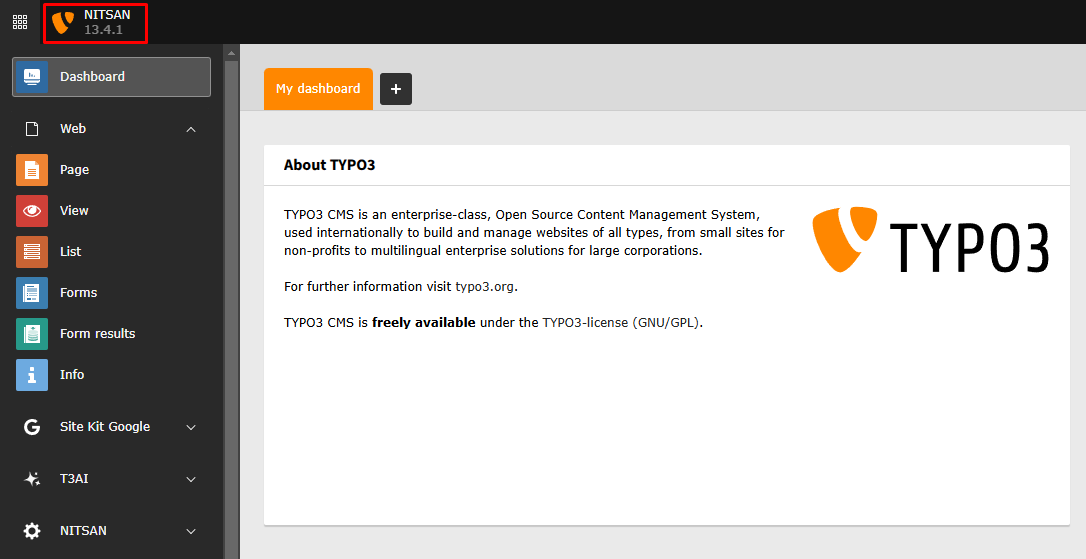
How to Check the TYPO3 Version in the Backend
- Log in to the TYPO3 backend with an account that has at least editor or administrator permissions.
- In TYPO3 v13 and v14, the installed TYPO3 version is typically visible:
- In the backend header,
- Within the System Information area,
- oO under the Environment module.
- Note both:
- The major TYPO3 version (for example, 11.5, 12.4, or 14.3),
- And the exact patch version.
The exact version determines:
- Which upgrade path is supported,
- Whether intermediate upgrade steps are required,
- Which PHP versions are compatible,
- And whether security support or ELTS coverage is still active.
How to Check the TYPO3 Version on the Server
The verification method depends on whether your TYPO3 installation uses Composer or a legacy non-Composer setup.
Composer-based TYPO3 installations
In Composer-managed projects, open the composer.json or composer.lock file and check the version constraint for:
typo3/cms-core
You can also run the following command in the project root:
composer show typo3/cms-core
This displays the currently installed TYPO3 core version and related package information.
Legacy non-Composer TYPO3 installations
In older TYPO3 installations without Composer, check the typo3_src folder or symbolic link on the server. The folder name usually contains the installed TYPO3 core version.
You can also review:
- The TYPO3 Install Tool,
- Version information in the backend,
- Or the
typo3/sysext/core/Documentation/files in older setups.
Identifying whether the installation is Composer-based is important because modern TYPO3 v13 and v14 projects are typically maintained through Composer workflows, which simplify dependency management and future upgrades.
Should You Upgrade or Relaunch?
One of the most important strategic decisions in a TYPO3 project is whether to perform a structured upgrade or invest in a complete relaunch. The right approach depends on several factors, including technical debt, extension compatibility, UX goals, accessibility requirements, compliance obligations, and available budget.
In many cases, upgrading to TYPO3 v14 LTS is the most cost-effective solution. In other situations, a relaunch delivers better long-term value than maintaining outdated architecture through multiple upgrade steps.
Typical TYPO3 Upgrade Scenarios
A structured TYPO3 upgrade is often the best option when the existing platform is technically healthy and the main goal is long-term maintainability.
TYPO3 v11 or v12 LTS with modern templates
Typical characteristics:
- Modern Fluid templating,
- Composer-based setup,
- Actively maintained extensions,
- Limited legacy custom code.
Goal:
- Retain the current UX and content structure,
- Improve security and performance,
- Modernise editor workflows,
- And migrate safely to TYPO3 v14 LTS.
TYPO3 v9 or v10 LTS with limited customisation
Typical characteristics:
- Stable website,
- Manageable extension landscape,
- Support windows approaching end-of-life.
Goal:
- Restore supported operation,
- Improve PHP and extension compatibility,
- And prepare the platform for future feature development.
Enterprise or public-sector websites with strict governance
Typical characteristics:
- Formal QA and deployment processes,
- Accessibility and GDPR requirements,
- Multiple stakeholders and approval cycles.
Goal:
- Complete a technically controlled TYPO3 upgrade first,
- Reduce operational and compliance risks,
- Then address UX or redesign topics in a later phase.
When a TYPO3 Relaunch Is the Better Choice
In some situations, a relaunch is more efficient and sustainable than upgrading multiple outdated TYPO3 versions.
A TYPO3 relaunch is often the better choice when:
- The website still runs on very old TYPO3 versions such as v4, v6, v7, or v8,
- Templates and extensions rely heavily on legacy architecture,
- The frontend is non-responsive or outdated,
- The information architecture no longer reflects business needs,
- Accessibility, SEO, or performance problems require structural redesign,
- Or the estimated upgrade effort approaches the cost of rebuilding on TYPO3 v14 LTS.
A relaunch allows organisations to:
- Modernise UX and branding,
- Simplify navigation and content structures,
- Remove obsolete extensions and technical debt,
- Improve accessibility and performance,
- And align the platform with current TYPO3 best practices in a single project cycle.
Role of ELTS and TYPO3 Support Windows
Extended Long-Term Support (ELTS) can provide additional time for planning a future TYPO3 upgrade or relaunch.
After regular TYPO3 LTS maintenance ends, ELTS offers continued security support for older TYPO3 versions for a limited period. This is especially useful when upgrades cannot begin immediately because of:
- Budget planning cycles,
- Complex third-party integrations,
- Organisational approval processes,
- Or large-scale migration dependencies.
However, ELTS should be viewed as a temporary risk mitigation strategy, not as a long-term substitute for upgrading to a supported TYPO3 LTS version.
Organisations using ELTS should still actively plan their migration path toward TYPO3 v14 and future TYPO3 releases.
Why Upgrading TYPO3 in 2026 Matters
Upgrading TYPO3 is not just about staying “up to date.” It directly affects the security, performance, maintainability, and long-term stability of your website.
With TYPO3 v14 LTS now established as the current long-term support release, 2026 is a strategic time for organisations to reduce technical debt, modernise infrastructure, and prepare their platforms for future TYPO3 and PHP development cycles.
Security and Long-Term Support
TYPO3 LTS versions receive continuous bug fixes and security updates throughout their support lifecycle. Older TYPO3 installations gradually lose this protection, increasing operational and compliance risks over time.
TYPO3 v14 LTS provides a stable foundation for long-term planning with:
- Ongoing maintenance and security updates,
- Compatibility with modern PHP versions,
- Improved dependency management through Composer,
- And predictable upgrade paths for future TYPO3 releases.
For organisations handling sensitive customer, enterprise, or public-sector data, remaining on supported TYPO3 versions is an important part of risk management and compliance strategy.
Performance and Stability
TYPO3 v14 includes ongoing improvements in:
- Caching and system performance,
- Database efficiency,
- Image processing,
- Backend responsiveness,
- And modern PHP compatibility.
These optimisations help reduce loading times, improve stability under higher traffic, and support better user experiences across desktop and mobile devices. Faster websites can also contribute positively to SEO performance and user engagement metrics.
Features and Editor Experience
TYPO3 v14 continues the modernisation of the TYPO3 backend and editor workflows with improvements such as:
- A cleaner and more consistent backend interface,
- Improved usability for page and file management,
- Enhanced accessibility support,
- Better handling of content editing workflows,
- And continued evolution of Fluid templating and modern TYPO3 APIs.
These improvements help editors work more efficiently while reducing administrative overhead for content teams.
SEO, Accessibility, and GDPR Considerations
Modern TYPO3 versions support better technical SEO foundations through:
- Improved performance and Core Web Vitals,
- Modern image handling,
- Cleaner frontend output,
- And built-in SEO capabilities.
TYPO3 v14 also helps organisations implement more maintainable accessibility and GDPR-oriented setups through modern security standards, configurable logging, cookie management integrations, and improved backend accessibility support.
However, TYPO3 itself does not guarantee legal compliance. Accessibility, WCAG/BITV conformity, and GDPR requirements should always be validated through dedicated technical and legal reviews.
How to Analyse Your Existing TYPO3 Site Before Upgrading
A structured technical analysis is the foundation of a successful TYPO3 upgrade. Before upgrading to TYPO3 v14 LTS, identify outdated extensions, unsupported APIs, infrastructure limitations, and potential compatibility risks early. This helps create realistic timelines, budgets, and rollback plans.
Technical Audit Checklist
Focus on the most important parts of the TYPO3 installation:
Core and extensions
- Current TYPO3 version and patch level
- Installed TER and custom extensions
- Compatibility with TYPO3 v14 and supported PHP versions
Infrastructure and PHP
- Server operating system and web server setup
- PHP and database versions
- Composer and deployment workflows
Templates and integrations
- Fluid templates and TypoScript structure
- Legacy frontend implementations
- External integrations such as CRM, SSO, search, or payment systems
Performance and logging
- Page loading times and caching
- Error logs and deprecation warnings
- Existing bottlenecks or recurring issues
Using ns_ext_compatibility for Extension Checks
NITSAN’s ns_ext_compatibility extension helps analyse TYPO3 extension compatibility across versions and identify upgrade blockers early.
The tool generates compatibility reports and highlights extensions that may require updates, replacements, or refactoring before upgrading to TYPO3 v14.
Risk Assessment and Rollback Planning
Document the main technical risks before starting the upgrade project.
Risk assessment
Identify:
- Deprecated APIs,
- Unsupported extensions,
- Heavy customisations,
- And critical business functions affected by the upgrade.
Backup and rollback strategy
Before every upgrade step:
- Create full database and file backups,
- Test rollback procedures,
- And maintain a staging environment for validation before go-live.
Estimating Effort and Budget for a TYPO3 Upgrade
A TYPO3 upgrade should be estimated based on the actual technical scope, not simply on the number of TYPO3 versions between the current and target release. Breaking the project into clear work packages makes timelines, risks, and budgets more transparent for stakeholders and clients.
Main TYPO3 Upgrade Effort Categories
Category | Typical Scope | Main Effort Drivers |
Core upgrade | TYPO3 version steps, Install Tool, configuration updates | Current vs target LTS version, required intermediate upgrades |
Extensions and custom code | TER updates, custom extension refactoring, deprecated API fixes | Number, age, and complexity of extensions |
Templates and frontend | Fluid migration, TypoScript updates, JS/CSS compatibility | Frontend architecture and design changes |
QA and bug fixing | Functional testing, regression fixes, performance optimisation | Site size, integrations, multilingual setup |
Deployment and coordination | Staging, go-live, rollback preparation, stakeholder communication | Infrastructure, approvals, release processes |
From Technical Audit to Concrete Proposal
Use the technical audit and compatibility analysis as the basis for realistic effort estimation instead of relying on rough assumptions.
For older TYPO3 installations, especially upgrades from TYPO3 v4 to v8, include additional buffer time for:
- Deprecated APIs,
- Unsupported extensions,
- Legacy templates,
- And unexpected migration issues.
A well-structured TYPO3 upgrade proposal should clearly separate:
- Core upgrade work,
- Extension modernisation,
- Frontend adaptation,
- QA and testing,
- And deployment activities.
This improves transparency and helps clients understand where technical complexity and potential risks exist.
Step-by-Step TYPO3 Upgrade Process
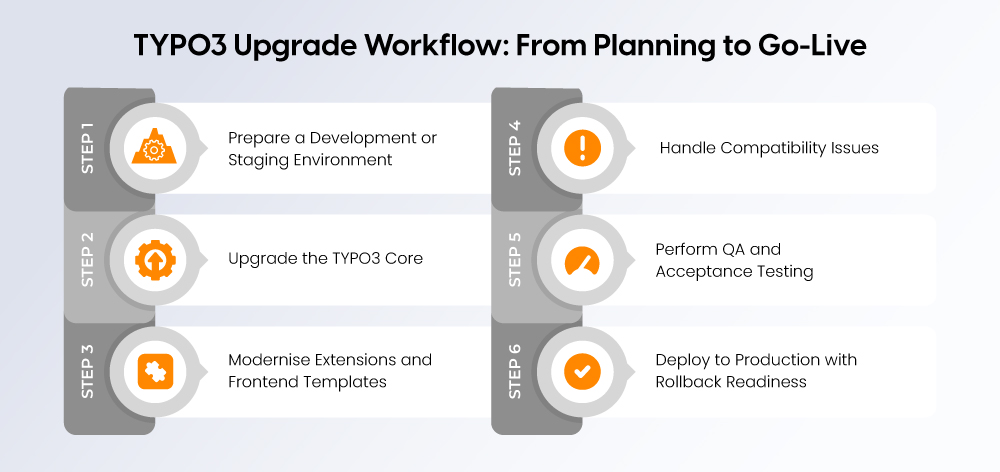
A structured TYPO3 upgrade process reduces technical risks and helps avoid disruptions to the live website. The exact workflow may vary depending on the organisation, but the following steps provide a proven framework for upgrading to TYPO3 v14 LTS.
Step 1: Create a Local or Staging Environment
- Create full backups of the database and filesystem.
- Restore the project to a local or staging environment.
- Match the production PHP and server configuration as closely as possible.
- Verify that the staging system behaves like the live website before starting the upgrade.
Step 2: Upgrade the TYPO3 Core
Upgrade TYPO3 incrementally using the recommended upgrade path, for example:
v10 → v11 → v12 → v13 → v14
Use:
- The TYPO3 Install Tool,
- Official upgrade wizards,
- Composer workflows,
- And TYPO3 upgrade documentation.
Update configuration and system settings to match TYPO3 v14 requirements.
Step 3: Update Extensions and Templates
- Update TER extensions via Composer or Extension Manager.
- Replace unsupported or abandoned extensions where necessary.
- Refactor custom extensions and Fluid templates to remove deprecated APIs and ensure TYPO3 v14 compatibility.
Step 4: Resolve Incompatible Extensions
Use tools such as ns_ext_compatibility and manual code reviews to identify incompatible extensions and deprecated functionality.
For each incompatible extension:
- Evaluate replacement options,
- Refactor custom code if required,
- Or remove obsolete functionality entirely.
Business stakeholders should be involved when functionality changes affect workflows or project scope.
Step 5: QA and User Testing
Deploy the upgraded TYPO3 installation to a DEV or testing environment and perform complete QA checks, including:
- Frontend rendering,
- Forms and logins,
- Integrations,
- Editor workflows,
- Performance,
- Accessibility,
- And error logging.
Editors and key users should validate daily workflows before approval for go-live.
Step 6: Go-Live and Rollback Preparation
- Schedule the production deployment.
- Create a final verified backup before launch.
- Deploy the upgraded TYPO3 version from staging to production.
- Monitor logs, performance, and error reports closely after release.
Always maintain a tested rollback plan in case critical issues occur during or after deployment.
Minor and Security Updates: Staying Safe Between Major Upgrades
Between major TYPO3 LTS upgrades, regular maintenance and security updates help keep the installation stable, secure, and supported. Although these updates are smaller than a full TYPO3 upgrade, they should still follow a controlled deployment and backup process.
Updating via the TYPO3 Backend
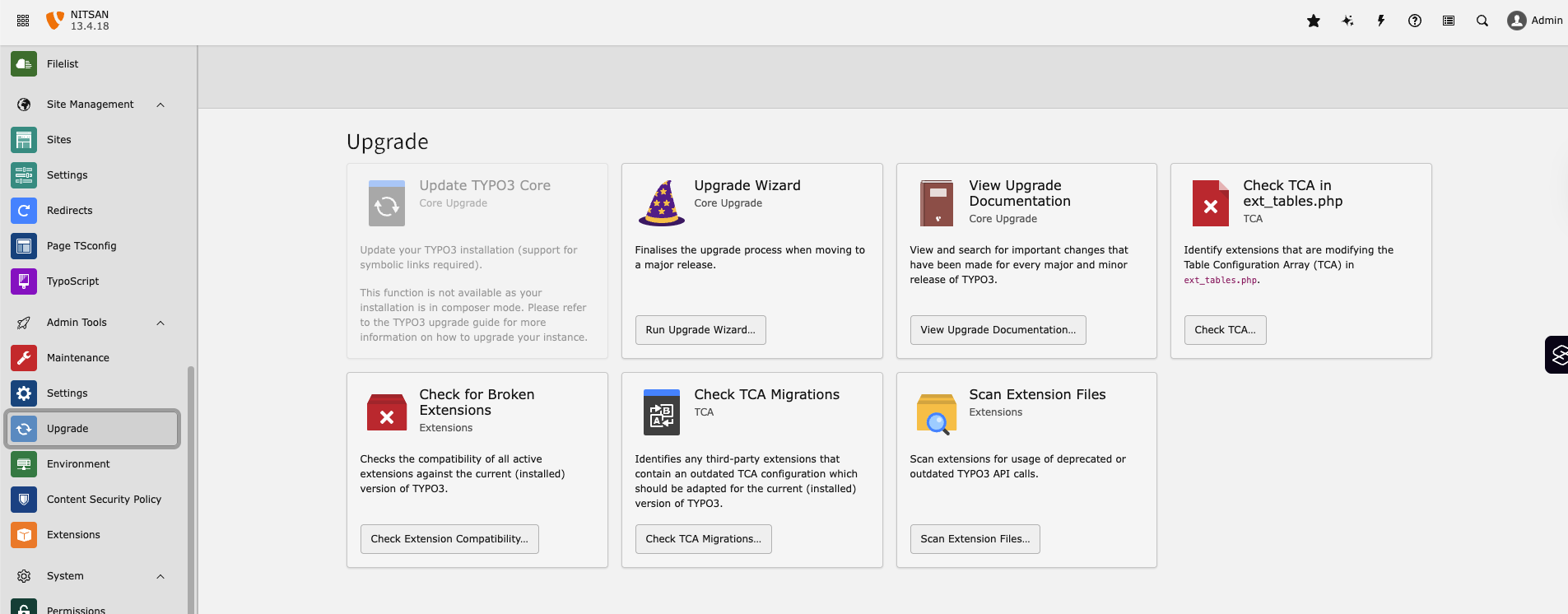
In supported installations, the TYPO3 Install Tool can update the TYPO3 core within the same LTS branch, for example:
TYPO3 14.1 → 14.3
This approach is suitable for smaller TYPO3 projects where:
- Hosting requirements are compatible,
- File permissions are configured correctly,
- Server tools are available,
- And backups can be restored quickly if needed.
Manual or Composer-Based Updates
For more complex TYPO3 installations, updates are typically performed manually or through Composer. This usually involves:
- Updating Composer dependencies,
- Replacing the TYPO3 core package,
- Adjusting version constraints,
- And running database upgrade procedures.
Composer-based updates provide greater control and are the preferred approach for enterprise, multi-server, and regulated environments with formal deployment workflows.
Which Update Method Should You Choose?
- Backend updates are often sufficient for smaller TYPO3 websites with simple hosting setups.
- Composer-based or manual updates are recommended for larger projects, custom deployments, and environments requiring documented change management and audit trails.
Regardless of the update method, always:
- Create verified backups,
- Test updates in staging first,
- And document each deployment step carefully.
Extension and Code Modernisation During Upgrade
A TYPO3 upgrade is the ideal opportunity to modernise extensions, remove deprecated APIs, and reduce long-term technical debt. This applies to both TER extensions and custom TYPO3 development.
Updating TER Extensions
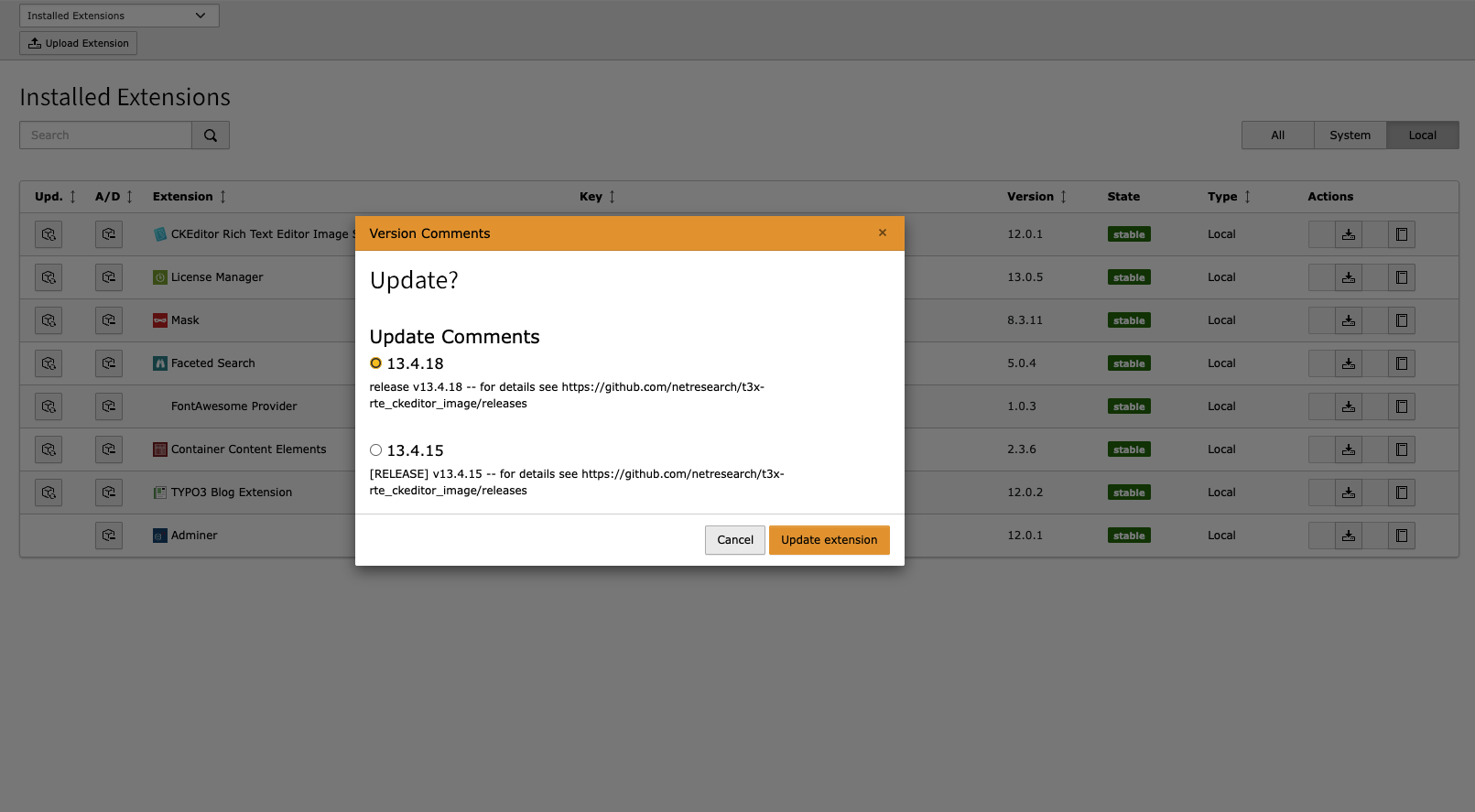
Many TYPO3 TER extensions can be updated directly through Composer or the TYPO3 Extension Manager by selecting versions compatible with the target TYPO3 release.
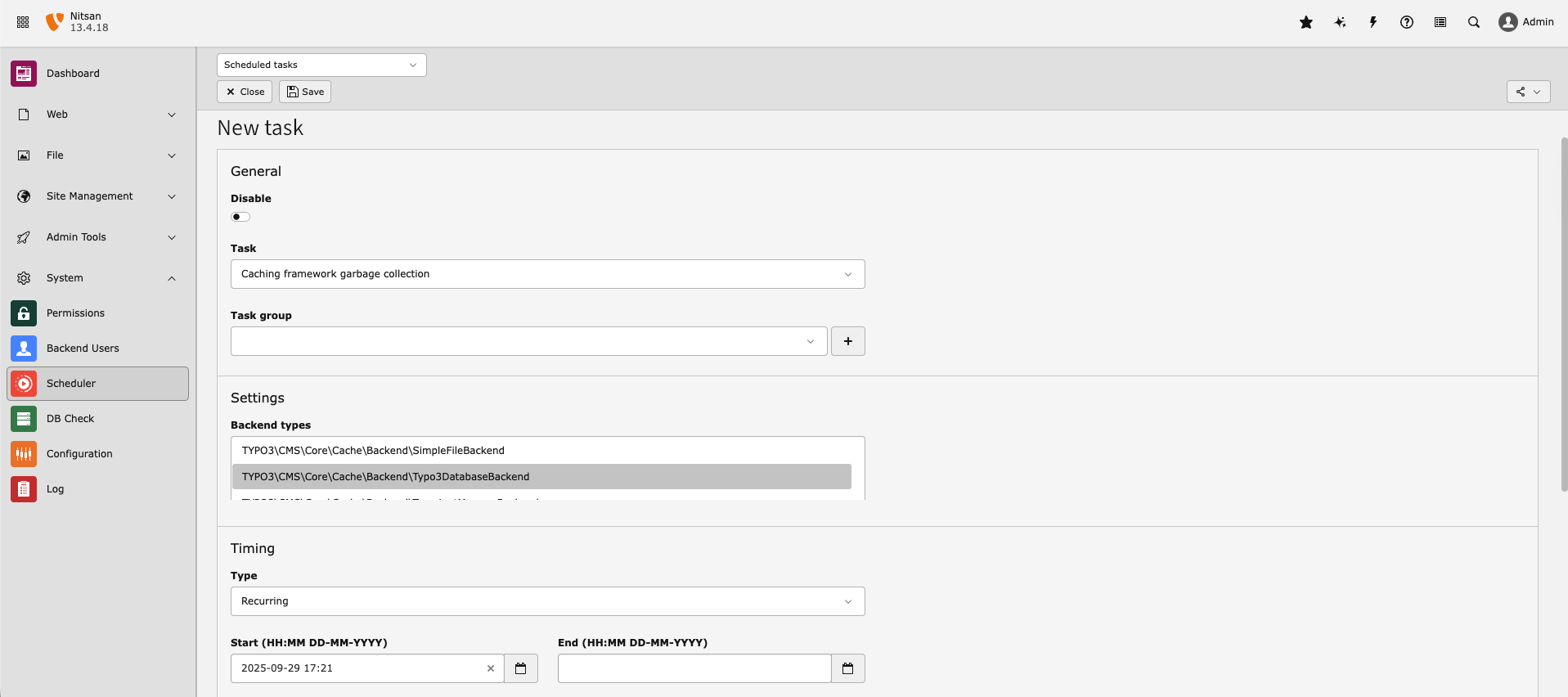
Refreshing the extension list helps identify:
- Compatible extension updates,
- Outdated dependencies,
- And unsupported extensions requiring replacement.
This approach works best when extensions are actively maintained and clearly define TYPO3 version compatibility.
If no compatible version exists, you may need to:
- Download updated packages manually from TYPO3 Extension Repository,
- Review dependencies carefully,
- And test the extension before deployment.
In some cases, replacing an outdated extension with a modern alternative is safer and more cost-effective than forcing compatibility.
Refactoring Custom Extensions and Deprecated APIs
Older TYPO3 In some cases, replacing an outdated extension with a modern alternative is safer and more cost-effective than forcing compatibility.
projects often contain custom extensions built on deprecated APIs such as:
piBase,t3lib_div,t3lib_extMgm,- Or legacy TCA structures.
During a TYPO3 v14 upgrade, these should be migrated to modern TYPO3 APIs such as:
- Extbase,
GeneralUtility,ExtensionManagementUtility,- PSR-based services and events,
- And modern TCA/TSConfig configuration patterns.
TYPO3 v14 removes additional legacy APIs compared to older TYPO3 versions, making extension modernisation a critical part of the upgrade process.
Handling Larger Code Migrations
Large migration projects should document:
- Deprecated API replacements,
- Database migration steps,
- Custom workarounds,
- And integration-specific changes
In internal technical documentation or migration playbooks rather than directly in the main project documentation.
Always validate implementation details against the official TYPO3 Core API and upgrade documentation because exact migration paths may change between TYPO3 releases.
QA and Go-Live: Checklists That Prevent Downtime
Thorough QA testing and a controlled go-live process help reduce regressions, performance issues, and unexpected downtime after a TYPO3 upgrade.
TYPO3 Upgrade QA Checklist
Phase | Focus Area | Key Checks |
Functional & UX testing | Core functionality | Navigation, page rendering, search, logins, forms, and critical user journeys |
| Backend workflows | Create, edit, and publish content in TYPO3 backend |
| UX & accessibility | Responsive layouts on desktop, tablet, and mobile devices |
|
| Basic WCAG/BITV accessibility checks for enterprise and public-sector websites |
Performance & monitoring | Performance | Compare loading times and Core Web Vitals against pre-upgrade baseline |
|
| Verify caching and check for slow database queries |
| Logs & errors | Review TYPO3 system reports, PHP logs, and deprecation warnings |
|
| Check browser console for JavaScript or frontend issues |
Post-launch | After deployment | Confirm Install Tool reports no critical issues |
|
| Verify scheduler tasks, forms, integrations, and transactions |
Stabilisation phase | Monitoring | Keep communication open with editors and support teams |
|
| Reserve time for urgent fixes before returning to normal maintenance |
TYPO3 Upgrade Kit and Further Resources
For organisations looking for a structured starting point, a dedicated TYPO3 Upgrade Kit can simplify planning, estimation, and execution. It provides reusable resources that help teams avoid rebuilding upgrade checklists and processes from scratch.
What the TYPO3 Upgrade Kit Includes
- Technical audit and upgrade planning checklists
- QA and go-live validation templates
- TYPO3 upgrade effort estimation templates
- Sample stakeholder and editor communication plans
- Resources for TYPO3 v14 upgrade preparation and long-term maintenance planning
Conclusion
Upgrading to TYPO3 v14 LTS helps organisations maintain security, long-term support, modern PHP compatibility, and a better editor experience. A structured upgrade strategy reduces technical debt, improves maintainability, and prepares your platform for future TYPO3 releases.
Whether you choose a direct upgrade or a complete relaunch, careful planning, extension analysis, QA testing, and rollback preparation are essential for a stable and successful TYPO3 project.
For complex enterprise, multilingual, or public-sector platforms, working with an experienced TYPO3 agency can help reduce migration risks and accelerate delivery.

Is Your TYPO3 Website Properly Secured?
Learn how to review system updates, user permissions, hosting security, and configuration settings.
FAQs
A TYPO3 upgrade moves your website from one TYPO3 LTS version to a newer one, updating the core, extensions, templates, and dependencies.
You should upgrade when support is ending, extensions become outdated, or security, performance, and editor workflows need improvement.
An upgrade modernises the existing system, while a relaunch rebuilds the website with a new design, structure, and technical setup.
The effort depends on the TYPO3 version gap, custom code, extensions, integrations, and overall project complexity.
TYPO3 ELTS provides extended security support for older TYPO3 versions when an immediate upgrade is not yet possible.
You can check it in the TYPO3 backend under System Information or by reviewing the typo3/cms-core version in Composer-based projects.
Test frontend functionality, forms, logins, integrations, editor workflows, performance, and error logs.
A relaunch is often the better choice for very old, heavily customised, or outdated websites where rebuilding is more efficient than upgrading.
No. Smaller projects can often be upgraded internally, while larger or more complex TYPO3 platforms may benefit from specialised agency support.

Contact for project management and team coordination
Mihaela Angelova
Project Manager - Germany

Mihaela Angelova
Project ManagerMihaela keeps technology projects on track and ensures to meet business goals. She specializes in coordinating teams, optimizing workflows, and delivering projects. At NITSAN, she works closely with clients to transform ideas into actionable solutions. Outside of work, she enjoys exploring new hiking trails.
Be the First to Comment