


TYPO3 CMS for Public Sector Websites: Requirements and Best Practices
Public-sector websites in Germany operate under strict legal and organisational requirements. Accessibility, data protection, documentation, and long-term availability are mandatory, not optional, and are enforced through laws, regulations, and procurement rules.
At the same time, institutions are expected to expand digital services and manage growing amounts of content across multiple departments. Many CMS platforms reach their limits here because they prioritize speed or simplicity while neglecting governance, stability, and maintainability.
Choosing a CMS is therefore a structural decision that affects compliance, risks, and operational effort for years to come. TYPO3 is often evaluated in this context because it is specifically designed for regulated environments and long project durations.
In this blog, we explain how TYPO3 CMS meets the requirements of the public sector in Germany and when it is the right choice.
Scope and target audience of this guide.
This section explains who this guide is intended for and who it is not, so that readers can quickly assess whether the content fits their tasks and project context.
Who this guide is written for
The target audience of this guide is organizations and teams working in regulated, long-term digital environments.
For example, the guide is relevant for:
- Public institutions and authorities in the DACH region and Germany
- IT leads, CTOs, and digital decision-makers responsible for CMS selection
- Stakeholders from procurement, compliance, accessibility, and data protection
- Agencies involved in the planning, implementation, or maintenance of TYPO3 projects for the public sector
The focus is on readers who need predictable systems, clear responsibilities, and long-term maintainability, rather than short-term successes.
Who this guide is not written for
Not every type of web project benefits from this guide.
It is not suitable for:
- Websites or microsites for short-term campaigns
- Organizations without defined maintenance or governance structures
- Teams seeking quick implementation with minimal process effort
- Projects where legal compliance, documentation, and audits do not play a role
If speed and simplicity are the only priorities, TYPO3 is generally not the right tool, and this guide does not attempt to make it so.
TYPO3 in the public sector: Key facts
For public institutions, CMS decisions are rarely based solely on features. Legal certainty, operational control, and long-term sustainability are more important than speed or convenience. The following overview summarizes how TYPO3 aligns with typical requirements of the public sector in Germany.
- Accessibility: TYPO3 supports accessibility according to BITV 2.0 and WCAG 2.1 Level AA, when accessible templates, structured content models, and documented audits are used. The CMS provides the technical foundation, while actual compliance depends on implementation and governance.
- Hosting and Infrastructure: TYPO3 is a self-hosted CMS. This allows operation on internal infrastructure or in certified German and EU data centers, in accordance with IT and security policies of the public sector.
- Data Protection: TYPO3 enables GDPR-compliant operation through complete control over data processing, storage, and third-party integrations. Legal compliance is achieved through configuration, hosting decisions, and organizational processes, not by the CMS alone.
- Support and Lifecycle Planning: TYPO3 follows predictable Long Term Support (LTS) cycles. This allows maintenance, upgrades, and budgets to be planned over several years, which is essential for public sector platforms.
- Typical Users: TYPO3 is frequently used by authorities, municipalities, universities, public law corporations, and other organizations operating in regulated and audit-driven environments.
Public Sector Website Requirements in Germany
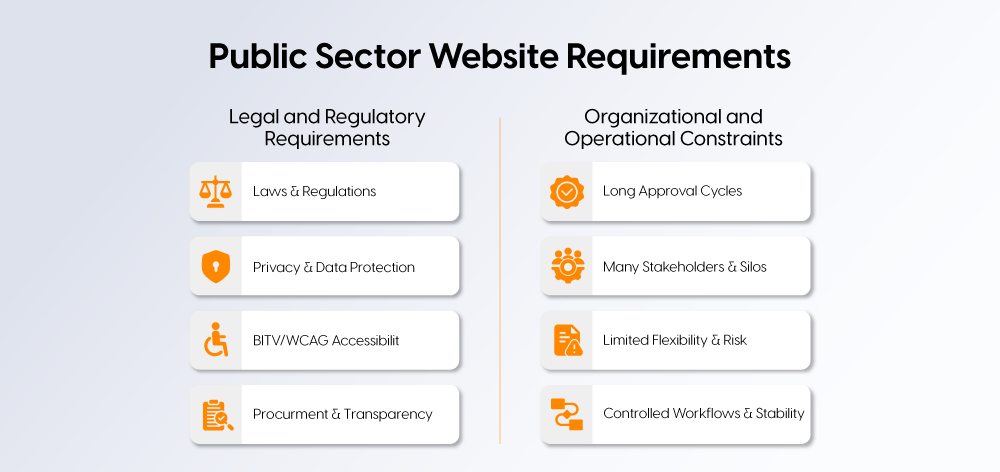
Public-sector websites in Germany are governed by a combination of legal obligations and operational realities. These requirements shape not only how websites are built, but also how they are maintained and audited over time.
Legal and Regulatory Requirements for TYPO3 Public Sector Sites
Digital services in public-sector areas must adhere to several norms that are still in force.
The most important of them are:
- GDPR for privacy, data consent and processing limitation
- BITV 2.0 and WCAG 2.1 Level AA for the accessibility of technology
- Transparency and verifiability requirements imposed by procurement and documentation rules.
Compliance is not a declaration from the organization’s side. Web pages must maintain a level of compliance that can be documented, and be firmly defended during audits and reviews.
Organisational and Operational Constraints in TYPO3 Public Sector Projects
Projects in the public sector encounter limitations not only due to compliance with legal rules but also with structures.
Such limitations mainly manifest as:
- Prolonged periods for approvals and decisions
- Involvement of many players from different divisions
- Exclusively little room for fast redesigns or frequent changes
CMS platforms should be able to provide an environment where the roles are clear, workflows are controlled, and stability is ensured for a long time.
If they do not, then it is very likely that informal practices or poor implementation of frequent changes will generate operational risks in that setting.
Why Many Public Sector Projects Rely on TYPO3
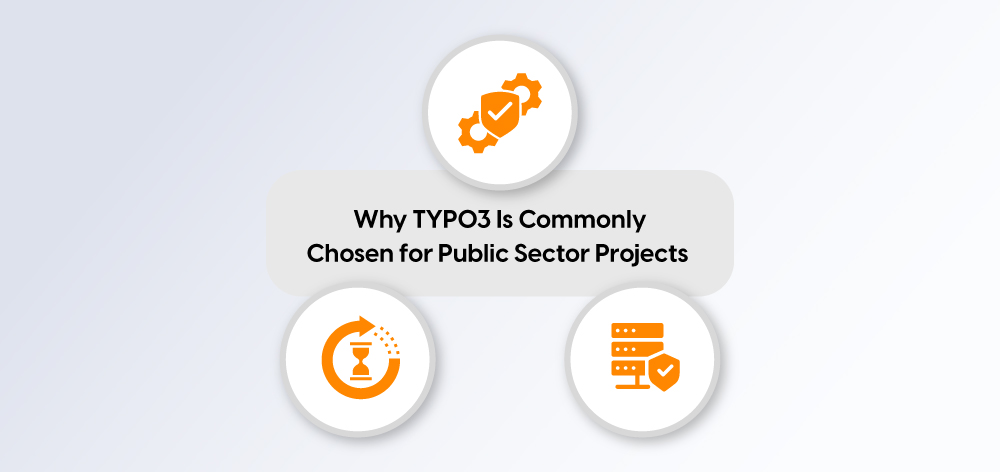
TYPO3 is often chosen for public sector projects because it is geared towards environments where governance, stability, and compliance are essential. Its architecture supports long-term operation and clearly defined responsibilities in complex organizations.
Governance and Rights Management in TYPO3 Setups for the Public Sector
Government websites and portals typically have many stakeholders with clearly defined roles. TYPO3 systematically addresses this issue.
The key points are:
- Fine-grained role and rights management
- Clear separation between authors, reviewers, and administrators
- Controlled release and publication workflows
The professional application of these mechanisms reduces sources of error and increases traceability during audits.
Stability and Long-Term Support for TYPO3 Platforms in the Public Sector
Public administrations need systems that can be operated stably over many years. TYPO3 offers a very predictable and reliable release and support cycle.
This supports the following scenarios:
- Planned upgrades instead of emergency migrations
- Long-term budget and resource planning
- Reduced risk from fundamental changes
Stability is a prerequisite, not an afterthought.
Self-Hosted Architecture and Data Control in TYPO3 Environments for the Public Sector
TYPO3 is by default a self-hosted content management system. This means that institutions retain control over data processing and infrastructure.
This enables the following aspects:
- GDPR compliance and data sovereignty: No conflicts with governmental data processing requirements, full control over the data
- Compliance with internal IT and security policies
- Operation in state or certified data centers
Data sovereignty always lies with the organization and not with the platform provider.
TYPO3 v13: Technical Foundation for Public Institutions
TYPO3 v13 builds on the governance-oriented architecture of the platform while simultaneously improving usability, performance, and integration capabilities. For public institutions, these changes increase operational security without compromising control or compliance.
Backend Usability and Editorial Security in TYPO3 Workflows of the Public Sector
Editorial teams in public institutions usually consist of users with very different technical knowledge. TYPO3 v13 improves the clarity of the backend to minimize errors and facilitate uniform content editing.
The main improvements are:
- Clearer backend navigation and content structures
- Faster response times for editorial actions
- Reduced risk of unintentional changes to live content
These improvements support daily work without weakening governance structures.
API and Integration Capabilities in TYPO3 System Landscapes of the Public Sector
Public sector websites are rarely isolated. TYPO3 v13 offers modern APIs that enable integration with existing, controlled systems.
Typical integration scenarios are:
- Connecting internal databases or registers
- Integration of search, document management, or identity systems
- Secure data exchange with third-party services
Each integration follows the rights and security model of TYPO3.
Long-term Maintainability of TYPO3 Installations in the Public Sector
Long-term operational capability is a fundamental requirement for projects in the public sector. TYPO3 v13 places a strong focus on maintainability.
As a result:
- The extension architecture is clearer
- There are defined upgrade paths between versions
- Technical debt is reduced through standard APIs
Maintainability is understood as a long-term responsibility, not a retrospective task.
How TYPO3 is used in real projects of the public sector
In public sector environments, TYPO3 is typically used as a long-term platform, not as a short-term website solution. Real projects show consistent patterns in the use of the system and where it delivers the greatest added value.
Typical TYPO3 Use Cases in the Public Sector
TYPO3 is one of the preferred solutions in the field of web publishing when content needs to be structured to be maintained collaboratively by many people.
Typical use cases are:
- Websites of local and regional authorities
- Universities and public research institutions
- Multi-site portals for ministries or agencies
These projects usually require the collaboration of multiple editors and have a long duration.
What Has Proven Itself in TYPO3 Practice in the Public Sector
When TYPO3 projects are well planned, the strengths of the system quickly become apparent in daily operations.
Practice shows that teams benefit from:
- Reduced editorial confusion through clear content models
- A combination of central governance and local editorial autonomy
- Stable operation over many years and versions
These strengths ensure predictable workflows and consistent quality.
Common Challenges in TYPO3 Projects in the Public Sector
Projects reflect reality and repeatedly bring similar issues to light.
The most common challenges include:
- Excessive customization with increasing maintenance costs
- Missing or outdated documentation
- Deferred upgrade planning until the critical point
Most of these problems are organizational in nature and can be avoided through proper planning.
Accessibility and Compliance in TYPO3 Projects of the Public Sector
For public sector websites in Germany, accessibility and compliance are not optional quality features. In TYPO3 projects of the public sector, they are legal obligations that permanently shape design, implementation, and operation.
Accessibility by Design in TYPO3 Websites of the Public Sector
The requirements for accessibility are supported in TYPO3 through the structured content approach and the templating system. This allows for an accessible output that meets the standards of BITV 2.0 and WCAG 2.1 Level AA.
Typical aspects include:
- Content with a structure that supports a correct heading hierarchy
- Control over semantic HTML and ARIA usage at the template level
- Support in checking accessibility during content creation
Accessibility is part of the system architecture and is not added retroactively.
What TYPO3 Does Not Automatically Solve in the Public Sector
TYPO3 does not ensure automatic legal compliance. In public sector projects, accessibility remains a shared responsibility.
TYPO3 does not automatically:
- Validate editorial decisions or content correctness
- Conduct manual accessibility audits
- Assume legal or organizational responsibility
Public institutions remain liable for non-compliance and documentation.
Audits, Monitoring, and Documentation in TYPO3 Projects of the Public Sector
In Germany, compliance with accessibility must be demonstrated. Structured audits and clear documentation are therefore central requirements in TYPO3 projects of the public sector.
Practically, this means:
- Regular automated and manual tests of accessibility
- Documentation of the resolution of identified issues
- Provision and maintenance of accessibility statements and feedback channels
TYPO3 technically supports these processes, but long-term compliance depends on clearly defined roles and workflows.
Risks, limitations, and what to avoid in TYPO3 projects in the public sector
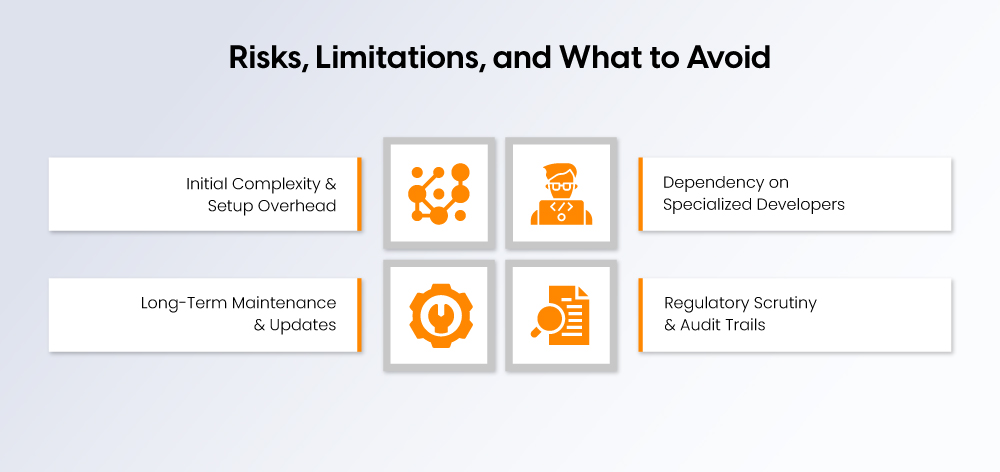
TYPO3 is well-suited for use in the public sector, but it is not without risks. Most problems do not arise from the CMS itself, but from planning, extension, and governance over time.
Best Practices Summary for TYPO3 Public Sector Projects
Public-sector TYPO3 projects succeed when technical, editorial, and organisational practices are aligned. The following best practices are based on long-running public-sector installations, not short-term delivery projects.
Technical and Coding Best Practices (with Examples)
Prefer TYPO3 core APIs over custom logic
Avoid bypassing TYPO3 internals. This ensures upgrade safety and predictable behaviour.
use TYPO3\CMS\Core\Utility\GeneralUtility;
$connection =
GeneralUtility::makeInstance(ConnectionPool::class)
->getConnectionForTable('pages');
Use proper dependency injection instead of makeInstance() in modern code
final class PageService
{
public function __construct(
private readonly PageRepository $pageRepository
) {}
}
This improves testability and long-term maintainability.
Register plugins and content elements via TCA overrides
ExtensionUtility::registerPlugin(
'My_extension',
'PublicContent',
'Public Sector Content'
);
Avoid runtime configuration or undocumented overrides.
Plan upgrades around TYPO3 LTS cycles
- No custom patches against TYPO3 core
- No hard coupling to deprecated APIs
- Changelog review is part of every upgrade
This prevents forced migrations during audits or security deadlines.
Editorial and Accessibility Best Practices (with Examples)
Enforce semantic structure via templates, not editor freedom
<h2>{content.title}</h2>
<p>{content.description}</p>
Editors should not decide heading levels manually.
Ensure alternative text is mandatory for media
'config' => [
'type' => 'file',
'appearance' => [
'showPossibleLocalizationRecords' => true,
],
'overrideChildTca' => [
'columns' => [
'alternative' => [
'config' => ['eval' => 'required']
],
],
],
]
Accessibility enforcement belongs in configuration, not training slides.
Limit editorial permissions clearly
- Editors: content only
- Reviewers: approval
- Admins: configuration
Avoid “everyone can publish” setups in public-sector contexts.
Governance and Operational Best Practices
Document responsibility, not just configuration
Public-sector TYPO3 projects should always document:
- Who owns accessibility compliance
- Who updates the accessibility statement
- Who approves releases and content changes
Documentation is part of compliance.
Integrate accessibility checks into workflows
vendor/bin/typo3cms install:checkenv
Combine automated checks with manual audits. Automation alone is not sufficient under BITV 2.0.
Treat TYPO3 as infrastructure, not a finished product
- Regular reviews aligned with legal requirements
- Scheduled audits
- Planned upgrades, not reactive fixes
TYPO3 works best when operated like a system, not a website.
Practical Takeaway
TYPO3 supports public-sector requirements technically. Compliance, accessibility, and long-term stability are achieved through process, discipline, and clear ownership, not through features alone.
When TYPO3 Public Sector Implementations Become Too Complex
Flexibility can be a double-edged sword and lead to TYPO3 being hard to maintain. This is the case with public-sector projects that have long lifecycles and many different stakeholders involved.
Some typical risk factors are:
- Extensive use of custom extensions without effective ownership
- Lack of documentation for complex permission structures
- Editorial workflows that are user-centric
All these factors lead to increased maintenance costs and slowed updates even in the future.
Common Mistakes in TYPO3 Public Sector Projects
The same issues are seen time and again at public institutions and agencies.
Among the most common mistakes are:
- Considering TYPO3 as a single delivery instead of a long-term system
- Feature addition without compliance impact checking
- Upgrade planning omitted in the early stages of the project
Usually, such decisions manifest later on as security, accessibility, or budget concerns.
How to Reduce Long-Term Risk in TYPO3 Public Sector Environments
Risk reduction in TYPO3 public sector projects is mostly a question of organization rather than technology.
Proper measures to be taken are:
- Unambiguous governance rules for extensions and integrations
- Content, compliance, and maintenance roles clearly defined
- Periodic reviews in line with TYPO3 LTS cycles
TYPO3 is at its best when the IT decisions are made according to the long-term realities of the public sector rather than the short-term project pressures.
Decision Framework: Is TYPO3 the Right CMS for Your Organisation?
Consideration | TYPO3 is a good fit | TYPO3 may not be the right fit |
Organisation type | Public institutions, public-law bodies, regulated enterprises | Small teams, campaign-only sites, temporary projects |
Project lifecycle | Long-term platforms with planned upgrades and maintenance | Short-lived websites with no long-term roadmap |
Governance needs | Clear roles, permissions, and approval workflows required | Informal or undefined editorial and approval processes |
Compliance requirements | Accessibility, GDPR, and documentation are mandatory | Compliance is minimal or treated as optional |
Hosting & data control | Self-hosted infrastructure and data sovereignty required | Fully managed or SaaS-only solutions preferred |
Operational capacity | Resources available for maintenance, updates, and audits | No capacity for ongoing technical or organisational upkeep |
Interpretation:
TYPO3 is designed for organisations that value structure, control, and long-term reliability. If these conditions are not present, the system’s strengths may become unnecessary overhead.
Conclusion
TYPO3 is built for organisations that view their website as long-term digital infrastructure, not a temporary project. In public-sector and regulated environments, success depends less on features and more on governance, compliance readiness, and operational discipline.
If you are considering TYPO3 for a public institution, the next step is not a redesign, but clarity: understanding accessibility risks, compliance obligations, and long-term maintenance effort before decisions are made.
You can start in two practical ways:
- Review your current accessibility status using the TYPO3 accessibility checker
- Discuss requirements, audits, or tender preparation through a direct inquiry
As a TYPO3 Agency experienced in German public-sector projects, NITSAN supports institutions in making decisions that are compliant, realistic, and sustainable over time.
FAQs
Yes. TYPO3 is widely used in German public-sector projects because it supports structured governance, role-based permissions, long-term support cycles, and self-hosted operation. These characteristics align well with legal, organisational, and accessibility requirements in public institutions.
TYPO3 can support compliance with BITV 2.0 and WCAG 2.1 Level AA, but it does not guarantee it automatically. Accessibility depends on templates, content, editorial workflows, and ongoing audits. TYPO3 provides the technical foundation; responsibility remains with the organisation.
TYPO3 follows predictable Long Term Support (LTS) cycles. This allows public institutions to plan upgrades, budgets, and maintenance over several years. With proper planning, TYPO3 installations often remain in use for a decade or more.
In most cases, yes. Public-sector TYPO3 projects involve compliance, accessibility, security, and long-term maintenance. Agencies with public-sector and TYPO3 experience help reduce risk and ensure that legal and organisational requirements are met from the start.
TYPO3 is not “officially endorsed” as a single mandatory CMS, but it underpins the federal Government Site Builder and is widely adopted across German authorities, which makes it a de facto standard in many public-sector environments.
A CMS must support templates and workflows that produce WCAG 2.1 AA‑conformant output in line with EN 301 549 and BITV 2.0, including accessible navigation, forms, documents, and compatibility with assistive technologies.
Typical TYPO3 LTS upgrades for public-sector sites range from a few weeks to several months, depending on project size, custom extensions, and testing and approval cycles.
There is no legally required certification, but agencies working with public institutions are usually expected to field TYPO3 CMS Certified Developers, Integrators, and Consultants, and to demonstrate accessibility and security expertise relevant for BITV and GDPR.
Contact for Internet agency and TYPO3 projects
Sven Thelemann
Service Partner - Germany


Sven Thelemann
Client Service LeadSven Thelemann serves as the Client Service Lead at NITSAN, focusing on delivering TYPO3 solutions that meet client goals. With a strong understanding of technology and client expectations, he ensures smooth communication and project execution. Outside of work, Sven enjoys cycling and experimenting with homemade recipes.
:
Hi there, I wish for to subscribe for this weblog to get most up-to-date updates,
thus where can i do it please assist. https://dhamhelicopter.wixsite.com/dham-helicopter-book/post/why-thousands-of-tirupati-pilgrims-fail-to-get-darshan-tickets-even-after-booking-opens WebSEOdynamics.com: Most locally-trusted SEO Services in Delhi NCR.
Today, I went to the beach with my children. I found a sea shell
and gave it to my 4 year old daughter and said "You can hear the ocean if you put this to your ear." She
put the shell to her ear and screamed. There was a hermit crab inside and
it pinched her ear. She never wants to go back! LoL I know this is totally off
topic but I had to tell someone! https://dhamhelicopter.wixsite.com/dham-helicopter-book/post/what-is-the-updated-vaishno-devi-helicopter-ticket-price-in-may-2026