


TYPO3 Agency vs TYPO3 Freelancer: Which One Is Right for You?
A TYPO3 agency or a TYPO3 freelancer? We compare costs, risks, capacity and support, and use a checklist to show which option fits your project.

In short: A TYPO3 agency fits projects that need several disciplines, fixed processes and ongoing operation. A TYPO3 freelancer fits clearly defined tasks with a fixed budget. What matters is not the hourly rate but scope, risk of downtime and support after go-live. Below you will find a cost comparison, a checklist and the most common questions.
I am Sven Thelemann, Client Service Lead at NITSAN GmbH, and I hear this question almost every week: "Should we hire a TYPO3 agency or is a TYPO3 freelancer enough?" Often it comes from companies that have already had a bad experience with one model or the other.
We are an agency ourselves, so we have an interest. That is why this article also says when a freelancer is the better choice. You will learn where the real differences lie (capacity, risk of downtime, quality assurance, support), how the costs add up and how to base the decision for your TYPO3 project on facts.
The options at a glance: agency, freelancer, in-house, hybrid
The question is rarely just "agency or freelancer". In practice there are four models:
- TYPO3 agency: A team handles concept, development, testing and operation. You sign a contract with one company.
- TYPO3 freelancer: One person delivers development or consulting on a project or hourly basis.
- In-house team: You hire your own TYPO3 developers. This pays off when development demand stays high, but it needs recruiting, management and cover planning.
- Hybrid: A freelancer or your in-house team works on the website, while an agency handles architecture, reviews, upgrades or operation.
This article mainly compares the first two models and shows when a hybrid model makes sense.
What is a TYPO3 agency?
A TYPO3 agency is a team of developers, designers, project managers and testers that takes responsibility for a project from concept to operation. You get one point of contact with several specialists behind them.
Strengths
- Several disciplines: Frontend, backend, design, SEO, hosting and testing sit in the same team.
- Cover: If someone drops out, a colleague who knows the code and the project takes over.
- Four-eyes principle: Code reviews and fixed routines for testing and approval.
- Operation after go-live: Maintenance, security updates and further development come from one source.
Limits
- Higher cost: Team, project management and infrastructure are part of the hourly rate.
- Slower start: Quote, alignment and kick-off often take several weeks.
- Indirect contact: At some agencies everything goes through the project manager. Ask upfront whether you can also speak to the developers directly.
An agency fits large or business-critical websites above all, and companies that want a long-term partner.
How a TYPO3 project runs with an agency
The process shows what you pay for with an agency, and which steps a freelancer has to cover alone:
- Concept: Goals, audiences, page structure, requirements and interfaces are clarified and written down.
- Design and UX: Wireframes and design take usability, brand and accessibility into account.
- Development: Templates, content elements, extensions and connections to other systems are built on TYPO3 standards.
- Quality assurance: Code review, tests across browsers and devices, and checks of performance and security on a staging environment.
- Go-live: Content is migrated, redirects are set, monitoring is set up and editors are trained.
- Operation: Updates, security updates, hosting, support and further development.
At an agency, each of these steps rests on several shoulders. That is what makes cover and quality assurance possible.
What is a TYPO3 freelancer?
A TYPO3 freelancer is a self-employed developer who offers TYPO3 services on a project or hourly basis. You talk directly to the person who writes your code.
Strengths
- Lower fixed costs: Without team overhead, hourly rates are usually lower.
- Direct line: No middle layers, agreements are quick.
- Fast start: Many freelancers can begin at short notice, ideal for small or urgent changes.
- Specialist knowledge: An experienced freelancer often knows one topic very deeply, such as a specific extension.
Limits
- Limited capacity: One person can only look after a limited number of projects at once.
- Risk of downtime: If they fall ill or go on holiday, the project stands still, and nobody who knows the code can step in.
- Processes depend on one person: Project management, testing and quality assurance depend on how they work. You are often more involved yourself as a result.
A freelancer fits smaller projects and clearly defined tasks above all, where budget, speed and direct collaboration count.
Not every freelancer is the same
Very different profiles work under the label TYPO3 freelancer. Check which one fits your task:
- Integrator: Configures TYPO3, builds templates and content elements and handles smaller adjustments.
- Extension developer: Programs in PHP, Extbase and Fluid, builds interfaces and custom features.
- Specialist: Focuses on one topic, such as performance, security, SEO or migration.
- Freelancer network or platform: Matches you with several people. Clarify who your contract partner is and who is liable for downtime or defects.
Official TYPO3 certifications are a sign of expertise but do not replace references. Ask for projects of a similar size and, if possible, speak to a former client.
Five questions that settle the decision
Instead of deciding by hourly rate, answer these five questions:
- How large and complex is the project? Several disciplines, many interfaces or several languages point to an agency. A clearly defined task points to a freelancer.
- What budget and schedule do you have? A freelancer often starts faster and cheaper. With fixed deadlines and several stakeholders, a team's capacity helps.
- Who looks after the website after go-live? Security updates and upgrades need someone who is reliably reachable. Settle this before the project starts.
- How much risk of downtime can you carry? For a website that drives revenue, cover matters more than for a simple business-card site.
- How much steering do you want to take on yourself? With a freelancer you usually coordinate design, testing and hosting yourself. An agency takes that on.
Two or three clear answers in one direction usually show which model fits you.
Cost comparison: TYPO3 agency vs. TYPO3 freelancer
Criterion | TYPO3 agency | TYPO3 freelancer |
Pricing model | Higher hourly or package price, team, project management and infrastructure included | Lower hourly rate, lower fixed costs |
Scope of service | Concept, design, development, testing, hosting and operation from one source | Mostly development, design, QA or hosting often external |
Project start | Quote, alignment and kick-off, often several weeks | Often possible at short notice |
Capacity | Several developers in parallel, also at peak times | Limited to one person |
Risk of downtime | Low, cover knows code and project | Higher, illness or holiday stops the project |
Quality assurance | Code reviews, tests, staging and approval process | Rests with one person, processes vary widely |
Maintenance & support | Maintenance contracts, security updates and fixed response times possible | By agreement, depends on availability |
Best for | Large or business-critical websites, relaunches, ongoing development | Small websites, single tasks, bug fixes, MVP |
What a TYPO3 project really costs: the cost drivers
TYPO3 itself is open source and, according to news.typo3.com, has no licence fee. Costs come from work and operation. A flat figure would be misleading, because scope and complexity set the price. These items drive it:
1. Planning and design
- Audiences, structure and wireframes
- Advice on content and marketing, if wanted
2. Development
- Templates and frontend implementation
- Adapting the backend for editors' work
- Custom features as an extension
- Connections to external systems, such as CRM or shop
- Multilingual setup and the number of countries or markets
- Migration of existing content
- Training your team
3. Operation
- Hosting and backups
- Updates: according to TYPO3, maintenance releases appear every 6 to 8 weeks, with security updates as needed
- Support, user management and care for new content
Which type of quote fits?
- Fixed price: Makes sense when the scope is clearly described. Check what is not included.
- Time and materials: Makes sense when requirements are still changing. Ask for estimates and regular effort reports.
- Maintenance contract: A fixed monthly or yearly frame for updates, security and support.
Calculate over three to five years, not just up to go-live. According to TYPO3, official support for a version is free for three years after release. After that you need a TYPO3 upgrade or extended support. This item belongs in every calculation, whether you choose an agency or a freelancer.
Who should you hire?
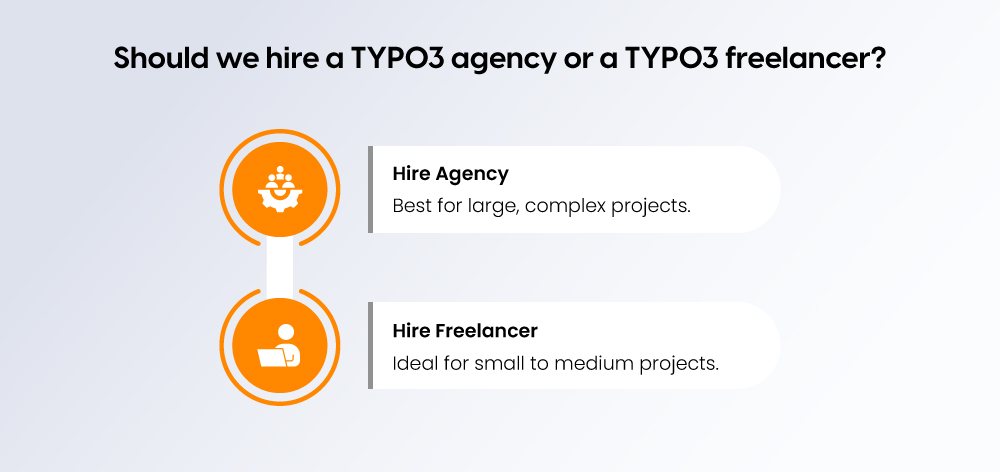
The best choice depends on size, complexity and your long-term plans. Both models have their place.
Hire a TYPO3 agency if:
- You run a large or enterprise TYPO3 website that has to scale and needs ongoing development and support.
- Your project needs design, development, TYPO3 SEO and regular maintenance at the same time.
- Your company needs fixed processes, defined QA steps and fixed response times.
Hire a TYPO3 freelancer if:
- You have a small to medium TYPO3 website with clearly defined requirements.
- You need to start quickly and the budget is limited.
- It is a single task, such as TYPO3 upgrades, a bug fix or a custom extension. Ready-made solutions are available as TYPO3 extensions and TYPO3 templates.
Quick checklist
- Need more than one discipline (development, design, SEO, hosting)? Rather an agency.
- Want fixed operation and fixed response times? Rather an agency.
- One clearly defined task with a fixed budget? Often a freelancer.
- Planning long-term development, such as upgrades and security updates? Rather an agency.
- Requirements still unclear? Get advice from a TYPO3 agency before you commit.
The middle path: freelancer first, agency later
For an MVP, starting with a freelancer can make sense. To make a later switch work, agree on three things from day one: a Git repository that you own, documentation of the installation and a transfer of usage rights to the code. For large corporate projects, also read our article on TYPO3 Enterprise.
How to choose your partner: 10 questions and warning signs
Ask these questions in the first call. Good partners answer them concretely and gladly.
- Which TYPO3 projects of a similar size have you delivered, and what can you show?
- Which TYPO3 version and setup do you work with (Composer, Git, staging)?
- Who will work on my project, and who covers if they are out?
- How do you secure quality (code review, tests, acceptance)?
- How do updates and security updates work after go-live?
- Who owns the code, repository and access?
- How do you handle change requests and extra effort?
- How quickly do you respond to an incident?
- How do we handle data protection, such as data processing agreements and hosting location?
- What does an exit look like if we switch later?
Warning signs
- No references you can check
- A fixed price without a written scope
- Access only via FTP, no Git
- No documentation and no word on updates
- Custom builds where TYPO3 standards would do
- Pressure to sign quickly
Contract and handover: what belongs in it
Whichever model you choose, put these in writing:
- Scope and acceptance: What exactly is delivered and how you recognise completion.
- Usage rights: You may use and modify the code and have third parties develop it further.
- Repository and access: The Git repository, server, domain and accounts belong to you or are handed over to you.
- Documentation: Installation, configuration, special features and update notes.
- Maintenance and response times: What happens regularly, who is reachable and within what time.
- Cover: Who takes over if someone is out.
- Data protection: A data processing agreement where personal data is processed, and the hosting location.
- Warranty: How defects are fixed.
- Exit: Notice periods and handover to a new partner.
This is practical guidance, not legal advice. For larger projects, have a lawyer review the contract.
Why a TYPO3 agency costs more and what is in the price
The higher hourly rate is not a markup on the same service. You are buying a different package. It includes:
- A full team: Project managers, developers, testers and sometimes SEO and UX specialists cover every area of your project.
- Better odds of clean TYPO3 code: Several TYPO3 developers review changes in a code review before they go live.
- Cover: If someone drops out, a colleague carries on. This reduces delays.
- Fixed routines: A staging environment, automated tests and a defined approval process keep quality stable across projects.
- Ongoing training: Developers stay up to date with new TYPO3 versions and methods.
If you do not need this package, an agency costs you too much. If your website brings in revenue or leads, it is often the cheaper choice, because downtime and rework fall away.
Risks and how to cover them
Both models carry typical risks. The difference is who absorbs them: with an agency it is the process, with a freelancer it is your contract.
Knowledge sits in one head
If only one person knows the project, one absence stops everything. Safeguard: documentation, a Git repository with history and a second person who knows the project.
Dependence on the provider
Custom-built solutions and foreign access make switching expensive. Safeguard: code, repository and access are yours, and the solution builds on TYPO3 standards and widely used extensions.
Uneven quality
Without a second pair of eyes, errors creep in. Safeguard: code reviews, coding guidelines, automated tests and a staging environment before every release.
Outdated TYPO3 version
A website nobody updates becomes a security risk. Safeguard: a maintenance plan, a Composer setup and a fixed date for TYPO3 upgrades.
Communication breaks down
Safeguard: named contacts, agreed response times and a ticket system instead of loose emails.
Budget runs away
Safeguard: a written scope, milestones and a clear process for change requests.
Scenarios: what fits which case?
Scenario | Usually the better fit | Why |
Small company website with few pages | Freelancer | Manageable scope, standard features |
Mid-size relaunch with design, SEO and multiple languages | Agency | Several disciplines, SEO migration and redirects |
Multilingual corporate site with many editors | Agency | Roles, scaling, interfaces and fixed response times |
Single extension or bug fix | Freelancer | Clearly defined task |
TYPO3 upgrade with many extensions and custom logic | Agency | Effort depends on extensions, tests and staging matter |
Ongoing operation with security updates | Agency, or a freelancer with a cover arrangement for small sites | Updates appear regularly and need reliable dates |
MVP or prototype | Freelancer | Fast and affordable, settle the handover from day one |
None of this is a rule. It shows the typical direction. More disciplines, more risk and a longer lifespan point to an agency.
Conclusion
There is no answer that fits everyone. A TYPO3 freelancer is a good choice for small, clearly defined tasks. A TYPO3 agency pays off once several disciplines, fixed operation or a real risk of downtime come in. Decide using the five questions, not by hourly rate alone.
Your next steps
- Write down goals, scope and deadlines on one page.
- Answer the five questions and check the matching scenario.
- Get two or three quotes and ask all of them the same ten questions.
- Clarify usage rights, repository, maintenance and cover before you sign.
- Plan operation and the next upgrade from the start.
NITSAN GmbH is a Gold Member of the TYPO3 Association and works as a TYPO3 agency in Germany with offices in Dresden, Berlin and Viernheim. If you are unsure, talk to us briefly. We will also tell you if a freelancer is enough for your plan.
Yours, Sven Thelemann
FAQs
The duration depends on scope, alignment and content. Small websites often take weeks, larger relaunches several months. Plan time for content, testing and training, not only for development.
Yes. Put scope, acceptance, usage rights to the code, cover and data processing in writing. This is not legal advice, so have the contract reviewed by a lawyer if needed.
According to TYPO3, maintenance releases appear every 6 to 8 weeks, with security updates as needed. Plan fixed maintenance dates and check who takes them on.
It depends on the scope. TYPO3 itself has no licence fee, costs come from planning, development and operation. Drivers are design, features, interfaces, multilingual setup, migration and maintenance. A reliable quote is only possible once requirements are clear.
Usually yes, because several people know the project: there is cover, code reviews, fixed testing and ongoing support. An experienced TYPO3 freelancer can also work very reliably. Their risk lies in availability and capacity, not in quality. Ask for references and who steps in if they drop out.
Per hour, usually yes, because team overhead falls away. Over the full project this can change: with a freelancer you often have to organise design, testing, hosting and maintenance separately, and rework costs extra. Compare the total scope including operation, not just the hourly rate.
Yes, many companies do. The switch runs smoothly if you agree three things from the start: a Git repository that you own, installation documentation and the usage rights to the code. Without them, an agency often has to analyse the existing setup before it can continue.
Look for TYPO3 references with comparable projects, a clear description of tasks and acceptance, and fixed rules for maintenance and security updates. Also ask about staging, version control and cover. Membership in the TYPO3 Association also shows commitment to the ecosystem.
Contact for Internet agency and TYPO3 projects
Sven Thelemann
Service Partner - Germany


Sven Thelemann
Client Service LeadSven Thelemann serves as the Client Service Lead at NITSAN, focusing on delivering TYPO3 solutions that meet client goals. With a strong understanding of technology and client expectations, he ensures smooth communication and project execution. Outside of work, Sven enjoys cycling and experimenting with homemade recipes.

Be the First to Comment