---
title: "Roadmap for TYPO3 v14 – UX, AI Tools & Migration Plan"
url: "https://nitsantech.de/en/blog/typo3-v14-roadmap"
description: The TYPO3 v14 roadmap is here and is all set to release in April 2026 with improvements in UX, standard themes, AI-powered tools, and easy migrations.
image: "https://nitsantech.de/fileadmin/_processed_/b/d/csm_TYPO3-v14-Roadmap___-Release-Schedule_d03794006f.jpg"
date: 2025-06-03
modified: 2026-04-21
lastUpdated: 2026-04-21
keywords:
- "typo3 v14
roadmap for typo3 v14"
categories:
- TYPO3 CMS
---
# Roadmap for TYPO3 v14 – UX, AI Tools & Migration Plan
TYPO3 v14 Roadmap & Release Schedule (2026): Features, Timeline, Upgrade Strategy
=====================================================================================
04 Jun 2025
[](https://nitsantech.de/en/blog/author/sven-thelemann)
[Sven Thelemann](https://nitsantech.de/en/blog/author/sven-thelemann)
[ TYPO3 CMS ](https://nitsantech.de/en/categories/typo3-cms)
TYPO3 v14 is the next major TYPO3 release, planned for April 2026 as an LTS version.
Table of content
This is not a routine update. TYPO3 v14 focuses on core improvements, cleaner architecture, more consistent APIs, and a better backend experience. These changes directly impact how websites are built, extended, and maintained.
For agencies, developers, and enterprise teams, this release is important for long-term planning. It affects upgrade strategy, extension compatibility, and future project decisions.
In this guide, you’ll get a clear overview of the TYPO3 v14 roadmap, key features, release timeline, and what to consider before upgrading.
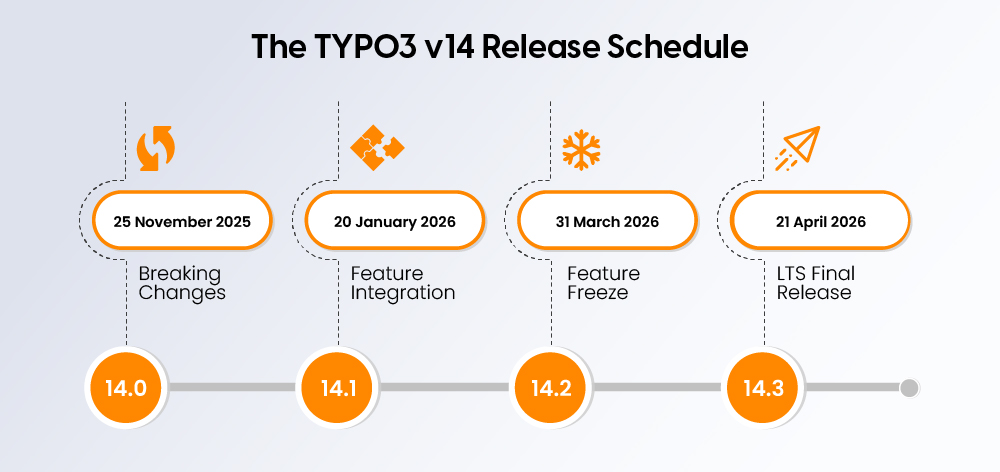
TYPO3 v14 is the next major version of [**TYPO3**](https://nitsantech.de/en/blog/typo3), planned for release in April 2026 as an LTS release.
In TYPO3, major versions are not just feature updates. They focus on long-term improvements to architecture, APIs, and system consistency, ensuring the platform remains stable and maintainable for enterprise use.
TYPO3 follows a structured and predictable release model, designed to balance innovation with stability. This approach allows agencies and enterprises to plan upgrades with confidence.
### **Key Roadmap Focus Areas**
- **System modernization**
Removal of legacy patterns and reduction of technical debt
- **API harmonization**
Cleaner, more consistent APIs for long-term extension stability
- **Backend usability**
Improved editor workflows and overall user experience
- **Structured content**
Better content modeling for scalable and multi-channel use cases
- **Enterprise-level stability**
Focus on maintainability, predictability, and long-term support
The TYPO3 v14 roadmap reflects **direction and priorities**, not a fixed feature list. Final scope may evolve before release.
### **Is TYPO3 v14 an LTS Release?**
Yes, TYPO3 v14 is planned as a **Long-Term Support (LTS) release**.
This includes:
- Long-term active support
- Extended security updates
- Suitability for long-running enterprise projects
For agencies and enterprises, LTS releases provide predictability, reduced upgrade pressure, and easier long-term planning.
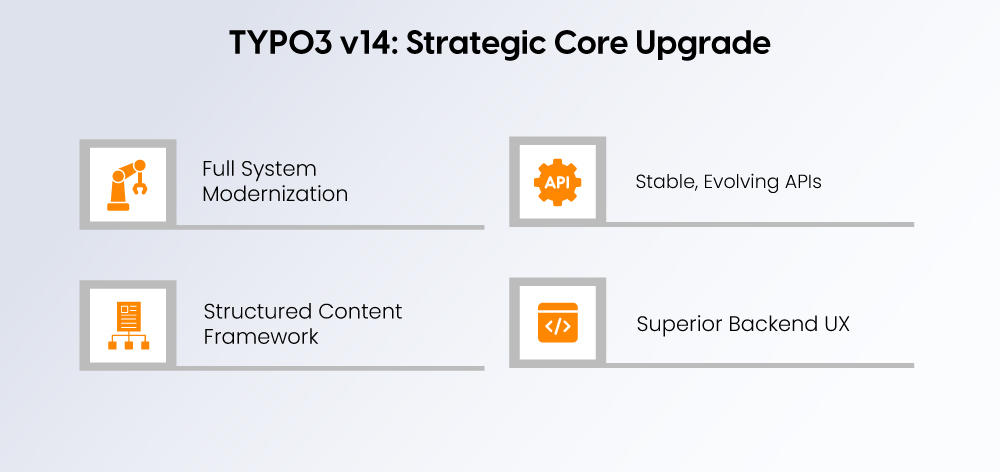
The TYPO3 v14 release has a well-planned approach to modernization.
### **System Modernization**
- Removal of legacy patterns
- Reduction of technical debt
- Improved long-term maintainability
### **API Stabilization and Evolution**
- Cleaner, more consistent APIs
- Removal of deprecated methods
- Stronger foundation for integrations
### **Structured Content Framework**
- Improved content modeling
- Better support for content blocks
- Clearer and more scalable data structures
### **Backend Usability Improvements**
- Cleaner interface
- More intuitive workflows
- Reduced friction for editors
Overall, TYPO3 v14 strengthens the platform’s foundation for **scalable, multi-channel, and long-term projects**.
### **TYPO3 v14 LTS Status & Lifecycle**
TYPO3 v14 is planned as a **Long-Term Support (LTS) release**, making it suitable for long-running enterprise projects.
#### **What LTS Means**
- Multi-year support window
- Long-term security updates
- Stable foundation for production systems
#### **Support Phases**
- **Active Support** → new features, bug fixes, security updates
- **Security-Only Phase** → critical fixes only
- **End-of-Life (EOL)** → no official support
#### **Why This Matters**
- Enables predictable **budget and upgrade planning**
- Reduces upgrade frequency and operational risk
- Supports compliance requirements in enterprise environments
For most organizations, LTS releases are the **recommended baseline for production systems**.
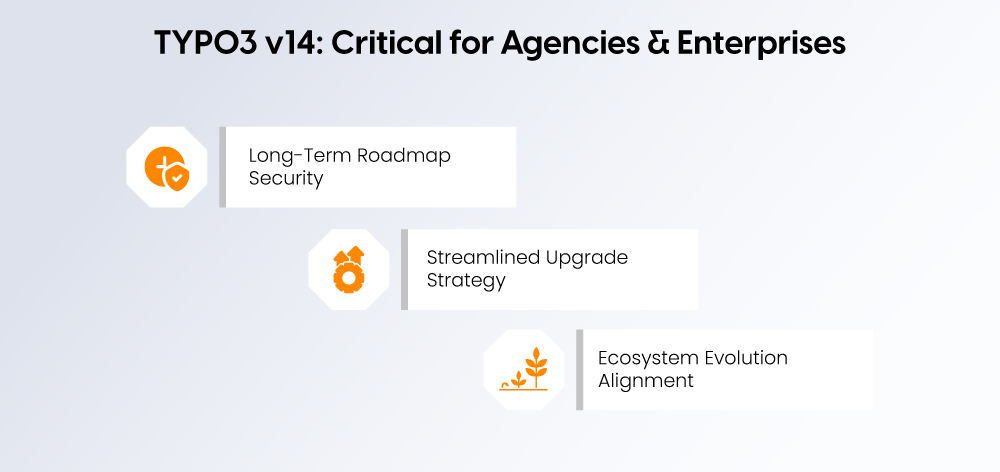
TYPO3 v14 has more implications for long-term planning than short-term functionality.
### **Long-Term Planning**
TYPO3 v14 is expected to define the **next stable upgrade cycle** for many organizations.
This directly impacts:
- Budget planning
- Upgrade roadmaps
- Ongoing maintenance strategy
Skipping an LTS release can significantly increase the **complexity and cost of future migrations**.
### **Upgrade Planning**
An immediate upgrade is not required, but **early preparation is critical**.
Recommended steps:
- Assess custom and third-party extensions
- Check compatibility with upcoming changes
- Set up staging environments for testing
- Align upgrade timing with business cycles
Delaying preparation until end-of-life phases often leads to **higher costs and time pressure**.
### **Ecosystem Alignment**
With every new LTS release, the TYPO3 ecosystem shifts:
- Extension development prioritizes the latest version
- Community support moves to the new standard
- Enterprises align their services and infrastructure accordingly
Staying aligned with the ecosystem helps avoid **compatibility gaps and last-minute decisions**.
TYPO3 v14 follows a **structured release cycle**, moving from early development to a stable Long-Term Support (LTS) release.
### **TYPO3 v14 Timeline Overview**
| **Stage** | **Description** | **What It Means for You** |
|---|---|---|
| **Development Phase** | Core features are developed and refined | Not stable → not for production use |
| **Feature Freeze** | No new features added; focus shifts to stability | Start planning upgrades and reviewing extensions |
| **Beta Releases** | Public testing phase begins | Ideal time to test compatibility in staging |
| **Release Candidates (RC)** | Near-final versions with high stability | Final validation before production readiness |
| **LTS Release (April 2026)** | Official stable release with long-term support | Safe for production use and enterprise adoption |
### **TYPO3 v14 Minor Releases (v14.1, v14.2)**
TYPO3 follows an **incremental release approach**, where early minor versions introduce refinements before the LTS release.
#### **TYPO3 v14.1**
**Focus:** Initial stabilization and early improvements
- First round of refinements after core development
- Early validation of new APIs and backend changes
- Initial feedback from real-world usage
Best suited for:
- Early adopters
- Developers testing extension compatibility
#### **TYPO3 v14.2**
**Focus:** Continued stabilization and feature maturity
- Further improvements to backend UX and APIs
- Better consistency across new features
- Fixes based on community feedback
Practical impact:
- More reliable testing environment
- Better preparation for LTS upgrade
- Reduced uncertainty for agencies planning migrations
#### **How to Use the Timeline Strategically**
- **Before Feature Freeze** → Monitor changes, avoid hard dependencies
- **During Beta** → Start testing extensions and integrations
- **During RC Phase** → Finalize upgrade planning
- **After LTS Release** → Execute production upgrades
The smartest approach is to **prepare during beta and upgrade after LTS**, not wait until end-of-life pressure builds.
**Key Insight**
TYPO3 v14 is not a single release, it’s a **progressive rollout**.
- v14.1 and v14.2 help **stabilize the platform early**
- The LTS release provides **long-term reliability for production**
Teams that engage early in the timeline gain a **significant advantage in planning, testing, and reducing upgrade risk**.
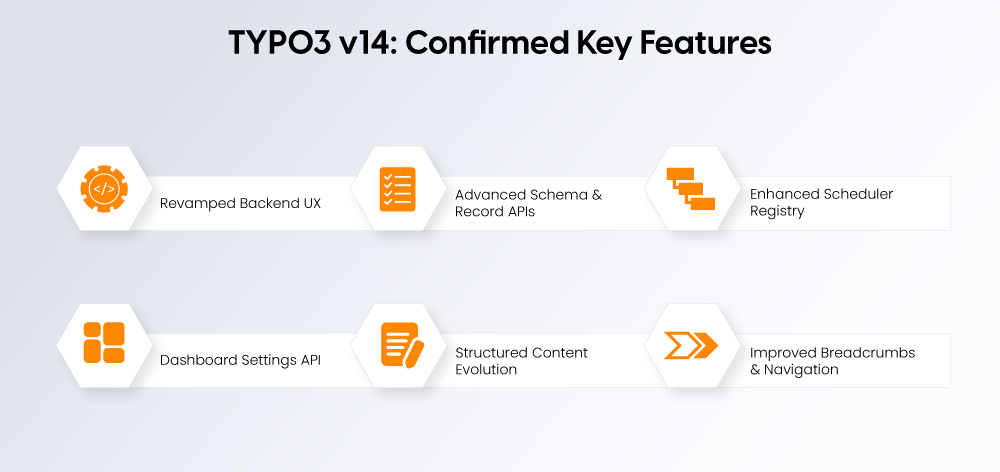
| **Feature Area** | **What Changed** | **Why It Matters** | **Who Benefits** |
|---|---|---|---|
| **Backend UX Improvements** | Cleaner interface, improved navigation, refinements in v14.2 | Faster editing, reduced friction in daily workflows | Editors, marketing teams, backend admins |
| **API Improvements (Schema & Record APIs)** | More consistent APIs, removal of deprecated methods, ongoing refinements in v14.2 | Predictable development, easier extension maintenance | Developers, extension authors, enterprise IT |
| **Scheduler Registry Updates** | Improved task registration and configuration | More reliable automation, fewer configuration errors | DevOps teams, system administrators |
| **Dashboard Settings API** | Enhanced dashboard configuration and personalization | Role-based dashboards, better backend overview | Backend users, agencies |
| **Structured Content & Content Blocks** | Improved content modeling, better content block support, v14.2 enhancements | Content reuse, headless readiness, scalable architecture | Developers, content architects, editorial teams |
| **Navigation & Breadcrumbs** | Simplified navigation logic, improved breadcrumb handling | Cleaner frontend implementation, consistent navigation | Frontend developers, agencies |
| **TYPO3 v14.2 Additions** | Incremental improvements across UX, APIs, and content handling | Stabilization before LTS, better upgrade readiness | Early adopters, developers, agencies |
Not sure of your TYPO3 version?
Check it now and take action.
-------------------------------------------------------------
Your TYPO3 Version:13.4
Congratulations, your TYPO3 system is up to date with version 13! We would be happy to take care of the maintenance and installation of regular system and security updates for you. [Contact us](https://nitsantech.de/en/inquire) now for a non-binding, customized quote!
Your TYPO3 Version:
With TYPO3 version 12, you still have some time before support expires at the end of April 2029. Nevertheless, we recommend upgrading to the latest version 13 to keep your system up to date. You will also benefit from the latest TYPO3 features. We would be happy to check your system for upgrade possibilities. [Contact us](https://nitsantech.de/en/inquire) now for a non-binding, customized quote!
You do not have a TYPO3 system, or we are unable to identify your version. Please contact us for an individual review of your system and a non-binding initial consultation regarding your TYPO3 upgrade. The upgrade is particularly critical for TYPO3 systems older than version 8, as the lack of further development and support can lead to acute security vulnerabilities. Let us plan your next [TYPO3 upgrade](https://nitsantech.de/en/services/typo3-upgrade-service) together!
Please enter a valid domain
The table below highlights the key technical differences between [**TYPO3 v13**](https://nitsantech.de/en/blog/typo3-v13-roadmap-announcement) and TYPO3 v14.
| **Area** | **TYPO3 v13** | **TYPO3 v14** | **Practical Impact** |
|---|---|---|---|
| **Architecture** | Continued modernization with some legacy support | Further cleanup and removal of legacy structures | Cleaner long-term foundation; review custom code |
| **API Structure** | Stable APIs; deprecated methods still available | Stricter APIs; deprecated methods removed | Extension updates may be required |
| **Developer Workflow** | Established patterns with compatibility layers | More structured approach; reduced legacy handling | Short-term adjustment; improved maintainability |
| **Extension Ecosystem** | Broad compatibility; mature ecosystem | Some extensions require compatibility review | Extension audit recommended before upgrade |
| **Backend User Experience** | Stable and functional interface | Cleaner layout; improved consistency | Easier editor onboarding and daily use |
[  ](https://www.linkedin.com/posts/typo3-gmbh_typo3-typo3v14-typo3conference-activity-7399129911673659392-mrQs "TYPO3 version 14.0")
TYPO3 v14 strengthens its position for **API-driven and hybrid (headless) architectures**, while maintaining its traditional CMS capabilities.
### **API & Headless Direction**
- Improved API consistency and structure
- Removal of deprecated methods
- Better long-term integration stability
### **Headless Suitability**
- Supports structured content models
- Suitable for API-based and hybrid setups
- Works well for multi-channel publishing
### **Limitations**
- Not headless-first by default
- Requires custom frontend implementation
- Some extensions may need adjustments
TYPO3 v14 is best suited for headless projects where **structure, governance, and long-term maintainability** are priorities.
TYPO3 v14 introduces AI cautiously, focusing on **editor support rather than automation**.
### **What’s Included**
- AI-assisted editorial tools
- Integration possibilities with external AI services
### **What’s Not Included**
- No full content automation
- No replacement of editorial workflows
- No built-in compliance guarantees
### **Governance & Compliance**
- AI-generated content requires review processes
- External AI tools may raise data protection concerns (especially in regulated markets)
- Legal and compliance checks remain necessary
TYPO3 v14 supports AI as an **assistive layer**, not a replacement for human workflows.
TYPO3 v14 focuses on long-term platform improvement rather than isolated feature additions.
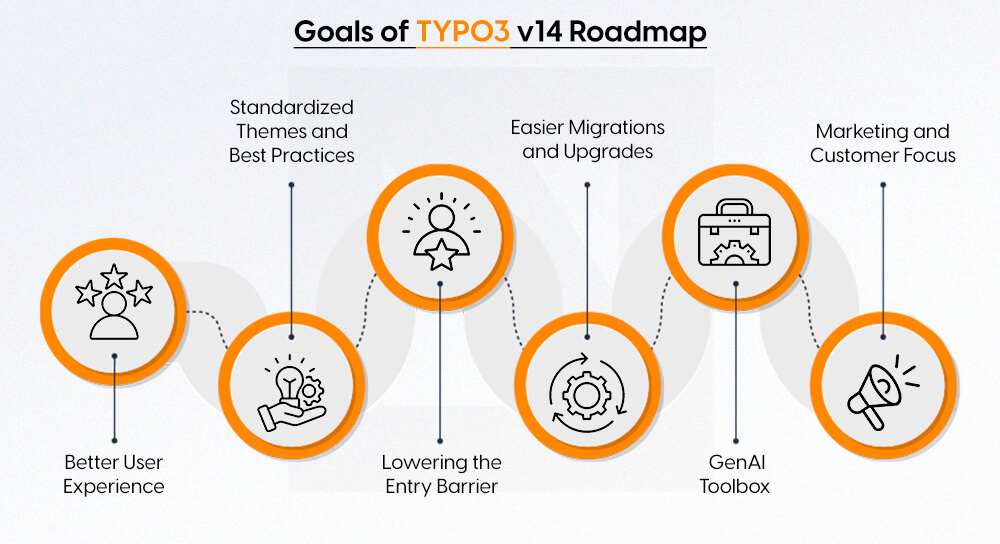
### **Backend Usability Improvements**
- Improved interface
- Improved accessibility
- Improved workflows
**Goal:** Improve editor and administrator usability.
### **Standardization & Best Practices**
- Improved coding standards
- Improved project structure
- Improved implementation patterns
**Goal:** Improve project consistency and reduce technical debt.
### **Improved Onboarding**
- Improved documentation
- Improved setup instructions
**Goal:** Lower the barrier to entry without sacrificing architectural integrity.
### **Upgrade & Migration Improvements**
- Improved deprecated code handling
- Improved migration paths
**Goal:** Improve long-term upgrade experiences.
### **AI Tooling (Carefully Introduced)**
- Content editorial support tools
- Optional AI integration
**Goal:** Enable content teams without replacing governance workflows.
### **Ecosystem Strengthening**
- Improved positioning
- Support for agencies and developers
**Goal:** Preserve a stable open source ecosystem.
Curious about the costs for your TYPO3 upgrade? We provide you with the answer!
-------------------------------------------------------------------------------
TYPO3 v14 introduces **breaking changes focused on removing legacy code and enforcing modern standards**. These changes primarily affect custom development and older extensions.
### **Key Breaking Changes**
- **Removal of deprecated APIs**
APIs marked as deprecated in earlier versions (v12/v13) are fully removed in v14
- **Stricter coding and architectural standards**
Extensions must follow updated TYPO3 core patterns and conventions
- **Backend/UI adjustments**
Changes in backend behavior and structure may impact editor workflows
- **Extension compatibility risks**
Not all third-party extensions will be immediately compatible
### **Practical Examples**
- Extensions using deprecated Extbase or TypoScript patterns may **fail or require refactoring**
- Custom integrations relying on outdated hooks or APIs may **break after upgrade**
- Backend modules may need **UI adjustments** to align with updated layouts
### **Key Risk Insight**
The **biggest upgrade risk** comes from:
- Custom-built extensions
- Unmaintained or outdated third-party plugins
Early compatibility checks and code reviews are essential to avoid upgrade blockers.
TYPO3 v14 requires a **modern and validated infrastructure environment**. Preparing your stack early is critical for a smooth upgrade.
### **Core Requirements**
- **PHP Version**
An updated PHP version will be required (confirm exact version closer to release)
- **Database Compatibility**
Ensure your database system meets TYPO3’s supported versions
- **Composer-Based Setup**
[**TYPO3 installations**](https://nitsantech.de/en/blog/installing-typo3) are expected to follow Composer-based workflows
### **Infrastructure Considerations**
- **Hosting environment**
Validate server configuration, performance, and compatibility
- **CI/CD pipelines**
Update build and deployment processes if needed
- **Environment consistency**
Ensure staging and production environments match
### **Key Priority**
Infrastructure readiness should be treated as an **early-stage task**, not a final step before deployment.
Delays in validating PHP versions, hosting, or pipelines can **block or slow down the entire upgrade process**.
Upgrading to TYPO3 v14 requires a **structured and phased approach**, especially for projects with custom extensions or legacy code.
### **Step-by-Step v14 Upgrade Path**
Follow a systematic process to reduce risk and avoid disruptions:
1. **Audit current TYPO3 setup**
Review core version, extensions, and custom code
2. **Remove deprecated code**
Clean up outdated APIs and legacy implementations
3. **Review and update extensions**
Ensure compatibility of all core, custom, and third-party extensions
4. **Validate infrastructure**
Check PHP version, database, and hosting environment
5. **Set up staging environment**
Test the upgrade in an isolated environment
6. **Run** [**TYPO3 upgrade**](https://nitsantech.de/en/services/typo3-upgrade-service) **tools**
Execute official upgrade wizards and database migrations
7. **Perform QA and deploy**
Conduct full testing before production rollout
### **Upgrade Complexity & Risk Assessment**
Upgrade complexity depends on your project setup:
- **Low complexity** → Standard installations with maintained extensions
- **Medium complexity** → Projects with some customizations
- **High complexity** → Legacy code, outdated or unmaintained extensions
**Key risk factors:**
- Custom extensions requiring refactoring
- Deprecated APIs removed in v14
- Unsupported third-party plugins
Projects with heavy customization should plan for **additional development and testing effort**.
### **Upgrade Timeline Planning**
Start early to avoid last-minute pressure:
- Begin preparation **3–6 months before the LTS release**
- Use **beta versions** for early compatibility testing
- Plan time for **post-release stabilization and fixes**
Early planning reduces both **cost and operational risk**.
### **Migration Checklist**
Use this checklist to stay organized:
- Audit all extensions (core, custom, third-party)
- Validate PHP version and infrastructure readiness
- Remove deprecated code
- Set up and configure staging environment
- Perform regression and compatibility testing
- Plan and execute production deployment
A successful TYPO3 v14 upgrade depends on **early preparation, structured execution, and thorough testing**. Projects that start early and follow a clear process can significantly reduce risk and ensure a smooth transition.
This governance model reduces unpredictability and supports enterprise-level planning.
TYPO3 v14 is relevant for all TYPO3 users, but the **approach and priority differ by role**.
#### **Agencies**
- Opportunity to offer **upgrade audits and migration services**
- Need for **structured client communication and planning**
- Align services with the new LTS standard
#### **Enterprises**
- Plan upgrades as part of **budget and lifecycle management**
- Ensure **compliance and security alignment**
- Reduce long-term operational risk
#### **Developers**
- Align with updated **APIs and coding standards**
- Refactor and modernize **custom extensions**
- Test compatibility early during beta phases
In most cases, TYPO3 v14 should be part of your **next upgrade cycle planning**, even if migration is not immediate.
### **When not to Upgrade**
Upgrading to TYPO3 v14 is recommended, but **timing matters**.
**Consider delaying if:**
- Your project is **close to launch**
- Critical extensions are **not yet compatible**
- You have **limited development resources**
- Upgrade timing conflicts with **business priorities**
#### **Strategic Perspective**
Delaying an upgrade can be the right decision **in the short term**, but it should be planned, not ignored.
Treat delays as a **controlled, temporary strategy**, with a clear plan to upgrade before end-of-life to avoid higher costs and risks later.
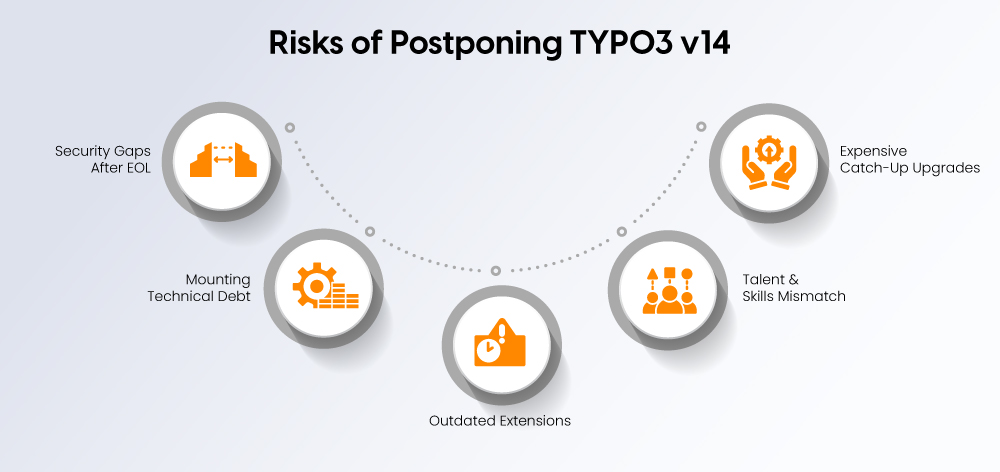
Delaying an upgrade to TYPO3 v14 may reduce short-term effort, but it often increases **long-term risk, cost, and complexity**.
### **Key Risks**
**Security Exposure After EOL**
Once a version reaches end-of-life (EOL):
- No security updates
- No bug fixes
- Increased compliance risk
Running unsupported systems creates both **technical and legal exposure**.
**Growing Technical Debt**
Staying on older versions leads to:
- Accumulated deprecated code
- Larger upgrade gaps over time
- More complex future migrations
Incremental upgrades are typically **faster and more cost-effective** than large version jumps.
**Extension Ecosystem Misalignment**
As TYPO3 evolves:
- Extension developers prioritize newer versions
- Older extensions receive fewer updates
- Compatibility gaps increase
This reduces alignment with the **active TYPO3 ecosystem**.
**Higher Future Upgrade Costs**
Skipping versions increases:
- Refactoring effort
- Testing complexity
- Overall project scope
Delaying even one LTS cycle can significantly increase **future upgrade effort and cost**.
### **Decision Insight**
Delaying TYPO3 v14 adoption can be a **valid short-term decision**, but it should be planned carefully.
In most cases, **early preparation and staged upgrades** provide the lowest long-term risk and cost.
TYPO3 v14 affects stakeholders differently. Planning should reflect your role and responsibility.
### **TYPO3 v14 for Agencies**
**Service Portfolio Implications**
- Growing demand for upgrade audits
- Extension refactoring services
- Infrastructure modernization support
Agencies should formalize structured upgrade offerings.
**Client Advisory Strategy**
- Communicate lifecycle timelines early
- Recommend compatibility audits
- Align upgrades with client business cycles
Clear guidance strengthens long-term client relationships.
### **TYPO3 v14 for Extension Developers**
**API Refactoring**
- Remove deprecated APIs
- Align with updated standards
Early testing during beta phases is recommended.
**Forward Compatibility**
- Avoid short-term patches
- Follow official API patterns
- Align with LTS roadmap expectations
Proactive alignment reduces future maintenance overhead.
### **TYPO3 v14 for Enterprise IT & Public Sector**
**Procurement Planning**
- Align upgrades with budget cycles
- Include testing and training resources
**Governance Alignment**
- Review editorial workflows
- Reassess extension strategy
**Compliance Review**
- Validate security configuration
- Confirm data protection alignment
- Review infrastructure policies
Early preparation supports risk reduction and operational continuity.
TYPO3 v14 aligns with long-term CMS developments while maintaining architectural discipline.
**Structured Content**
- Clear content modeling
- Reusable data structures
- Multi-channel readiness
**API-First Direction**
- Improved API consistency
- Stronger integration capability
**AI-Assisted Workflows**
- Editorial assistance tools
- Human oversight remains required
**Governance-Centric Architecture**
- Strong role management
- Controlled workflows
- Enterprise stability focus
**LTS-Based Planning**
- Predictable lifecycle
- Clear upgrade paths
- Suitable for multi-year digital strategies
TYPO3 v14 represents structured evolution, focused on stability, clarity, and long-term value rather than short-term trends.
TYPO3 v14 represents a structured evolution of the platform. The focus is on architectural cleanup, API consistency, backend usability, and long-term maintainability.
For organizations running [**TYPO3 v12**](https://nitsantech.de/en/blog/typo3-v12) or v13, preparation should begin early. This does not require immediate migration, but it does require:
- Extension compatibility review
- Infrastructure validation
- Lifecycle planning
- Budget alignment
Agencies should formalize upgrade strategies.
Extension developers should align code with updated APIs.
Enterprise IT teams should integrate TYPO3 v14 into long-term roadmap planning.
TYPO3 v14 continues the platform’s stability-focused approach. It introduces modernization without compromising governance or long-term support principles.
Early, structured preparation reduces upgrade risk and protects long-term investment.
FAQs
----
When will TYPO3 v14 be released?
TYPO3 v14 LTS is planned for **April 2026**. Always confirm exact dates through official TYPO3 announcements.
Is TYPO3 v14 an LTS version?
Yes. TYPO3 v14 is planned as a **Long-Term Support (LTS)** release, suitable for multi-year enterprise projects.
Should I upgrade from TYPO3 v13 to TYPO3 v14?
Yes, in most cases.
Plan the upgrade carefully, review extension compatibility, and test before going live.
Will my TYPO3 extensions work in v14?
Not automatically.
Well-maintained extensions are likely to be updated, but custom or outdated extensions may require changes.
Does TYPO3 v14 include built-in AI?
TYPO3 v14 may include AI-assisted tools, but it does not replace editors or fully automate website creation.
Is TYPO3 v14 suitable for headless projects?
Yes. TYPO3 v14 supports headless and API-based setups, especially for structured and multi-channel content projects.
How long will TYPO3 v14 be supported?
As an LTS version, TYPO3 v14 is expected to receive several years of active support, followed by a security-only phase. Exact timelines depend on the official TYPO3 lifecycle policy.
#### Contact for Internet agency and TYPO3 projects
#### Sven Thelemann
Service Partner - Germany
[ st@nitsantech.de ](mailto:st@nitsantech.de) [ +49 351 48196661 ](tel:4935148196661)


### Sven Thelemann
Client Service Lead
- [](https://www.linkedin.com/in/sven-thelemann-0a30867b/ "linkedin")
Sven Thelemann serves as the Client Service Lead at NITSAN, focusing on delivering TYPO3 solutions that meet client goals. With a strong understanding of technology and client expectations, he ensures smooth communication and project execution. Outside of work, Sven enjoys cycling and experimenting with homemade recipes.
Comments and Responses
----------------------
Thank you for your comment. Your Comment Added Successfully.
Thank you for your comment. Your Comment Will Be Visible After Approval.
Oops! Something went wrong, please try again later.
##### **Be the First to Comment**
### Related Blogs
[ 
#### TYPO3 CMS for Public Sector Websites: Requirements and Best Practices
](https://nitsantech.de/en/typo3-public-sector-2026)
[ 
#### TYPO3 SEO: Improve Your TYPO3 Website Ranking
](https://nitsantech.de/en/blog/typo3-seo)