---
title: TYPO3 v13 AI Integration for Agencies – Practical Guide
url: "https://nitsantech.de/en/blog/typo3-v13-and-ai-integration"
description: Learn how TYPO3 v13 supports AI integration for agencies. Practical use cases, risks, and GDPR-focused guidance for Germany.
image: "https://nitsantech.de/fileadmin/_processed_/d/0/csm_TYPO3_v13-and-AI-Integration-for-Agencies_749278b340.jpg"
date: 2026-01-12
modified: 2026-02-09
lastUpdated: 2026-02-25
keywords:
- TYPO3 v13
- TYPO3 v13 AI
- TYPO3 v13 AI Integration
- TYPO3 automation
- TYPO3 for agencies
- AI in TYPO3 CMS
categories:
- Agency
---
# TYPO3 v13 AI Integration for Agencies – Practical Guide
TYPO3 v13 and AI Integration for Agencies: A Practical Guide
============================================================
03 Nov 2025
[](https://nitsantech.de/en/blog/author/sven-thelemann)
[Sven Thelemann](https://nitsantech.de/en/blog/author/sven-thelemann)
[ Agency ](https://nitsantech.de/en/categories/agency)
Artificial intelligence is becoming a part of the Internet's everyday activities. For agencies working with TYPO3, this evolution is more of a practical question than a theoretical one. Clients demand quicker deliveries, better quality, and stricter compliance all at the same time.
Table of content
With version 13, TYPO3 provides a stable technical basis that makes it possible to introduce AI in a controlled manner. AI doesn't change the core of [**TYPO3**](https://nitsantech.de/en/blog/typo3) but opens new door for automation and assistance wherever it is logical.
In this post, we will discuss how the TYPO3 v13 empowers agencies to AI integration in a responsible way, where the boundaries lie, and what has to be considered before making the next move.
Typically, TYPO3 agencies work within established frameworks for regulations and long-term project plans in Germany. Public institutions and business clients place great value on predictability, transparency, and written documentation.
New technologies are carefully proposed to ensure they meet established governance, security, and operational requirements.
### **Changing Operational Reality for Agencies**
At the same time, operational demands on agencies are growing. [**TYPO3 projects**](https://nitsantech.de/en/blog/typo3-projects-for-enterprises) are becoming more complex, not simpler.
Pressing issues include:
- Increase in content on websites, portals, and intranets.
- Meeting accessibility standards like WCAG and BITV.
- Increasing obligations for quality control and long-term maintenance.
- Low editorial and technical staff leading to inferior products.
### **Why Manual Processes No Longer Scale**
Many of these repetitive tasks follow obvious rules but still require manual work. These include content review, metadata creation, accessibility checks, and internal linking.
With all available hands, these tasks consume valuable time that could be used for planning, reviewing, and improving.
Manual processes work in small quantities but are not efficient when [**TYPO3 installations**](https://nitsantech.de/en/blog/installing-typo3) grow.
### **AI as Structured Support, Not Replacement**
AI is not about reorganizing teams or speeding up delivery. Its value lies in the idea that it makes work predictable and plannable, but also remains accountable to editors and developers.
**AI can help agencies:**
- Reduce repetitive editorial and technical work.
- Improve consistency across large TYPO3 installations.
- Provide suggestions that inform human decisions rather than negate them.
### **Why TYPO3 v13 Is the Right Moment**
This is possible within [**TYPO3 v13**](https://nitsantech.de/en/blog/typo3-v13-roadmap-announcement) because it allows AI integration without disrupting existing workflows. Better performance on the backend side, better APIs, and a stable extension system enable a controlled and transparent introduction of AI.
For agencies working in compliance-intensive environments, this timing is crucial. AI can now be evaluated and adopted as part of established TYPO3 processes, rather than as an external layer that bypasses responsibility.
The AI integration is important now because TYPO3 v13 allows agencies to explore automation without losing control, accountability, or long-term stability.
Not sure of your TYPO3 version?
Check it now and take action.
-------------------------------------------------------------
Your TYPO3 Version:13.4
Congratulations, your TYPO3 system is up to date with version 13! We would be happy to take care of the maintenance and installation of regular system and security updates for you. [Contact us](https://nitsantech.de/en/inquire) now for a non-binding, customized quote!
Your TYPO3 Version:
With TYPO3 version 12, you still have some time before support expires at the end of April 2029. Nevertheless, we recommend upgrading to the latest version 13 to keep your system up to date. You will also benefit from the latest TYPO3 features. We would be happy to check your system for upgrade possibilities. [Contact us](https://nitsantech.de/en/inquire) now for a non-binding, customized quote!
You do not have a TYPO3 system, or we are unable to identify your version. Please contact us for an individual review of your system and a non-binding initial consultation regarding your TYPO3 upgrade. The upgrade is particularly critical for TYPO3 systems older than version 8, as the lack of further development and support can lead to acute security vulnerabilities. Let us plan your next [TYPO3 upgrade](https://nitsantech.de/en/services/typo3-upgrade-service) together!
Please enter a valid domain
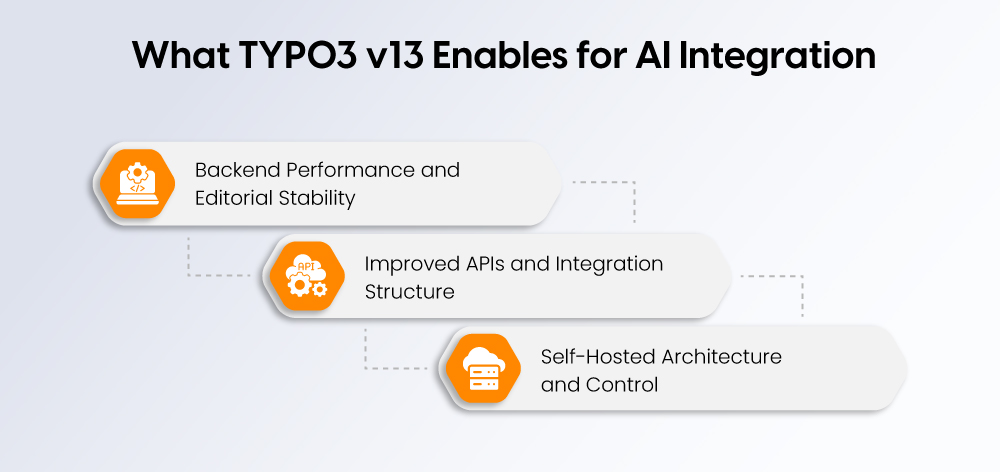
TYPO3 v13 brings several changes that enable the technical integration of AI without altering the governance or operation of the CMS.
The changes do not simply involve adding AI functionalities to the existing system; they create a stable environment where AI can be used in a controlled manner.
### **Backend Performance & Editorial Stability**
In TYPO3 v13, the backend performance and editorial workflow have been improved, making it easier for editors to use responsive backends with clear user interfaces. A fast response time and clear user interfaces are particularly important when AI-supported tools are integrated into workflows.
**With a responsive backend, editors can:**
- Display AI-generated recommendations without obstacles.
- Process additional information without slowing down the content.
- Integrate AI support instead of being interrupted by AI.
This stability is crucial for agencies with large TYPO3 installations that need to go through multiple editors and approval processes.
### **Improved API & Integration Architecture**
The most important aspect for the integration of AI in TYPO3 is the improved API and extension framework. This allows agencies to connect external or self-hosted AI technologies with TYPO3 without bypassing the core logic of the CMS.
#### **How This Impacts Your Agency**
- TYPO3 v13 enables agencies to integrate AI into TYPO3:
- Through established interfaces;
- With established responsibilities;
- Without altering the core functionality of TYPO3.
This ensures that AI becomes a part of the TYPO3 ecosystem rather than an unexplored external dependency.
### **Self-Hosted Architecture and Control**
TYPO3 remains an open-source enterprise-level CMS that is self-hosted. This stands in stark contrast to several SaaS-based platforms where AI is integrated into the provided service.
#### **Effects of AI Usage**
This means for agencies and clients:
- Total control over the location of their data processing.
- The choice of private or local AI models.
- Compliance with internal IT and compliance policies.
AI in TYPO3 v13 does not take over the CMS logic or the editorial decisions of the users. It transforms existing workflows into a system where editors and developers are supported by the system while governance, accountability, and long-term maintenance remain within the system.
The fact that TYPO3 v13 enables AI integration while simultaneously controlling the operational and technical aspects is crucial for enterprise and government projects.
Within TYPO3 v13, AI does not function as a standalone feature. It is integrated into existing CMS processes and supports editors and developers at defined points in the workflow without changing responsibilities or approval structures.
### **AI Support for Content Creation and Editing**
The AI features of [**T3AI**](https://t3planet.de/en/t3ai-typo3-extension) can help editors create articles, draft summaries, and suggest metadata values. In the TYPO3 interface, AI makes the process more advantageous for editors as long as they retain control.
All AI-generated outputs must be reviewed. Humans must ensure they are legally correct and in the right tone and context. TYPO3 integrates the review of all AI-generated outputs into all current editorial workflows.
### **Search & Information Access**
One of the most common issues with large TYPO3 installations is the low quality of internal search functions. AI-supported internal search tools like [**T3AS**](https://t3planet.de/en/t3as-typo3-extension) improve relevance by providing users with context instead of relying solely on keyword searches.
The following types of TYPO3 projects will benefit from using T3AS:
- Public portals
- Knowledge platforms
- Corporate intranets
### **Quality and Accessibility Testing**
Accessibility regulations like [**WCAG**](https://nitsantech.de/en/accessibility-glossary/wcag) and BITV are mandatory for many German projects. Projects using AI-supported accessibility testing with extensions like [**T3AA**](https://t3planet.de/en/t3aa-typo3-extension) benefit from the ability to identify missing alternative text, improper use of headings, and contrast issues.
It is important to note that automating accessibility fixes is helpful, but it is the responsibility of the project team to align the fixes made by AI with accessibility legislation and guidelines.
### **Workflow Automation**
AI can support repetitive tasks as follows:
- Tagging of content
- Suggestions for metadata
- Classification of images
This improves consistency without removing editorial control.
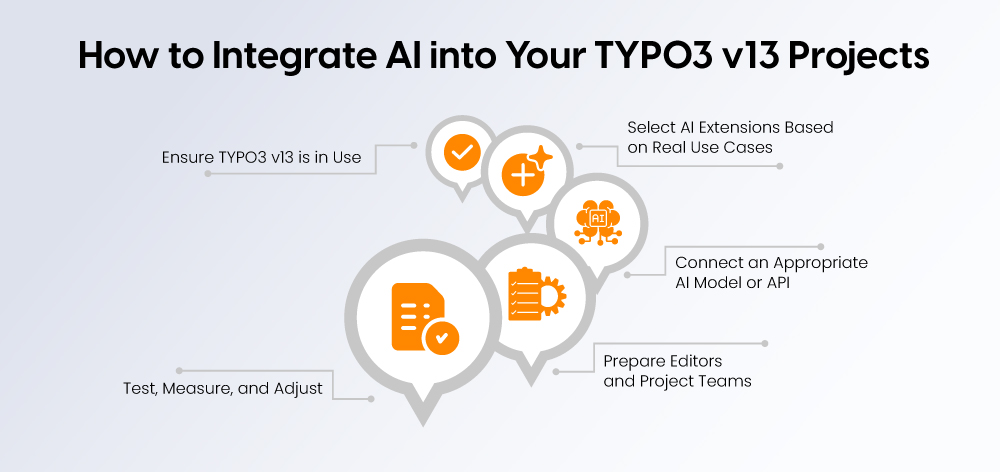
The introduction of AI into TYPO3 projects works best when it follows a clear, step-by-step approach. TYPO3 v13 provides the technical foundation, but successful integration depends on preparation, governance, and continuous review.
### **1. Ensure TYPO3 v13 Is in Use**
AI integration should only begin after upgrading to TYPO3 v13. This version offers:
- Improved APIs and extension architecture
- Modern PHP support
- Greater system stability
These elements are required to reliably execute AI-supported functions without affecting the behavior of the core CMS.
### **2. Select AI Extensions Based on Real Use Cases**
AI is typically introduced in TYPO3 through extensions developed for specific tasks, such as:
- Editorial and content support
- Search and information discovery
- Accessibility checks and quality assurance
The extensions integrate directly into the [**TYPO3 Backend**](https://nitsantech.de/en/blog/typo3-backend), allowing editors and developers to use AI functions within familiar workflows instead of switching tools.
**Selection Criteria for Agencies**
- Clear scope and purpose
- Compatibility with TYPO3 v13
- Transparent data processing
### **3. Connect an Appropriate AI Model or API**
Once the extensions are selected, agencies can decide how to connect AI services. Common options are:
- External AI APIs
- Self-hosted or local models
- Private APIs that comply with customer policies
This flexibility allows agencies to align innovation with data protection and compliance requirements.
### **4. Prepare Editors and Project Teams**
AI outputs should always be treated as suggestions and not as final results. Editors and teams need clear instructions on:
- Reviewing AI-generated content
- Validating accessibility or SEO suggestions
- Maintaining editorial responsibility
Short training sessions help set expectations and prevent misuse.
### **5. Test, Measure, and Adjust**
After integration, agencies should monitor how AI affects workflows and outcomes. TYPO3's reporting and analysis tools can support this process. Adjustments should be made gradually to ensure that AI aligns with project goals and long-term maintenance strategies.
AI integration in TYPO3 v13 works best when it follows a controlled process and is not conducted as an experimental introduction.
Curious about the costs for your TYPO3 upgrade? We provide you with the answer!
-------------------------------------------------------------------------------
TYPO3 agencies see the greatest benefit from AI integration when it is applied to specific operational challenges rather than abstract experiments. In TYPO3 v13, AI works best in scenarios where the effort scales faster than the available resources.
### **High Content Volume and Editorial Load**
Agencies managing large websites, portals, or multisite installations often deal with constant content updates. AI can support editors by taking over repeatable tasks such as draft suggestions, summaries, or metadata suggestions.
**This is particularly useful when:**
- Content updates are frequent
- Multiple languages are involved
- Consistency across pages is required
AI reduces the preparation effort while maintaining editorial responsibility.
### **Distributed Editorial Teams**
TYPO3 projects often involve editors working across departments or locations. AI can help support common standards by suggesting consistent structures, terminology, and formatting.
**Typical Benefits**
- Fewer inconsistencies in tone and structure
- Faster onboarding for new editors
- Reduced reliance on manual guidelines
### **Accessibility and Quality Assurance**
Accessibility checks are mandatory in many German projects. AI can help identify recurring issues such as missing alternative texts, incorrect heading order, or contrast problems before manual review begins.
This does not replace reviews but reduces the initial workload.
### **Search and Information Quality**
For portals and intranets, search quality directly impacts usability. AI-supported search improves relevance by interpreting context rather than relying solely on keywords, which is crucial for service-oriented platforms.
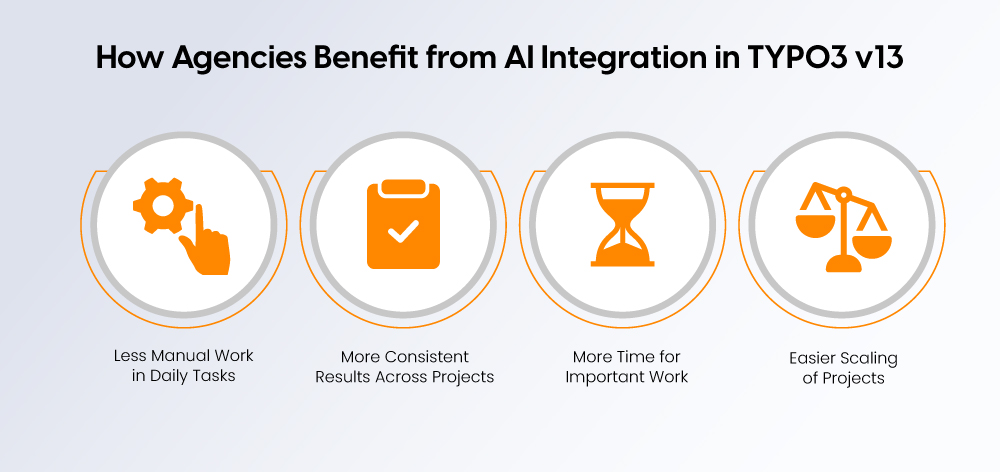
AI can help TYPO3 agencies when used in a clear and controlled manner. The goal is not to change the way teams work, but to reduce the effort on repetitive tasks.
### **Less Manual Work in Daily Tasks**
AI can support editors and developers with basic tasks such as draft suggestions, simple metadata ideas, and initial checks for accessibility issues. This saves time without changing existing TYPO3 workflows.
### **More Consistent Results Across Projects**
When agencies manage many [**TYPO3 websites**](https://nitsantech.de/en/blog/typo3-website), it is difficult to maintain the same level of quality. AI helps apply the same rules and checks for content and structures, reducing differences between projects.
### **More Time for Important Work**
By reducing routine work, teams can spend more time on planning, reviewing content, and solving technical problems. These tasks still require human judgment and cannot be automated.
### **Easier Scaling of Projects**
AI helps agencies manage more content and larger websites without manual work increasing at the same pace. This makes it easier to manage long-term TYPO3 projects while maintaining quality and control.
When AI is used carefully, it supports agency work without adding unnecessary complexity.
The integration of AI brings efficiency, but it also creates new risks when applied without clear boundaries. In TYPO3 projects, uncontrolled automation can weaken quality, accountability, and compliance.
### **Potential problems arising from AI**
Problems arising from excessive automation are often difficult or time-consuming to fix once they are established. Common issues include:
- Lack of consistency in tone and messaging across different content
- Incorrect information in legally binding publications
- Loss of all editorial authority and responsibility among publishers
The risks associated with publishing AI-generated outputs increase dramatically if a publisher has not established structured review or approval processes before the publication process.
### **Common Agency Errors**
TYPO3 agencies should avoid:
- Publishing AI-assisted created content without human review.
- Using third-party cloud services to store their data without retaining control over their data.
- Believing that AI-generated outputs are literal or final publications.
### **Importance of Maintainability**
All TYPO3 projects should be developed with the goal of lifelong use. AI should follow the same principles.
Automation should be used to create workflows that valuable support current operations and do not create new, unrecognized dependencies and/or compliance issues that increase the complexity of ongoing maintenance.
In German TYPO3 projects, data protection is important for most public sector and regulated industries. In addition, TYPO3’s self-hosted architecture gives the agency more control over how and where it uses AI services.
**The most common ways of doing things are as follows:**
- Use a private or restricted API.
- Use self-hosted AI models.
- Define how any data will be processed and stored.
Before an organization can use AI in a production-level TYPO3 environment, it must develop a governance framework that meets current recordkeeping standards and establishes clear accountability for collecting, storing, and using data.
The integration of AI into TYPO3 should be a conscious decision and not a standard step. Agencies benefit the most when the technical and organizational foundation is already in place.
### **When to Integrate AI into TYPO3 v13**
The integration of AI into TYPO3 v13 is possible when:
- It is deployed and used productively.
- There are documented, structured editorial and approval processes.
- Responsibilities regarding compliance and data protection are documented.
- The team has the ability to independently review and manage AI-generated outputs.
### **When to Delay AI Integration into TYPO3**
If POs (project managers) have not yet migrated all projects from older TYPO3 versions to the latest version, it would not make sense to implement AI support until:
- The editorial responsibility of a project is not understood or defined.
- The available maintenance resources are already overused or overloaded.
This framework should help digital agencies accurately assess their readiness and decide whether they should wait to implement AI into their TYPO3 installations until the necessary processes are established.
TYPO3 v13 enables agencies to integrate AI in a structured and responsible way. When used correctly, AI reduces manual effort, improves consistency, and supports compliance. For organisations planning to explore AI within TYPO3, the key is not speed, but readiness.
If you are evaluating how AI could fit into your TYPO3 v13 projects, working with an experienced [**TYPO3 agency**](https://nitsantech.de/en/typo3-agency) can help you assess feasibility, define boundaries, and integrate AI in a way that remains stable, compliant, and future-proof.
FAQs
----
Is AI allowed in TYPO3 websites under GDPR?
AI can be used in TYPO3 websites under GDPR if data processing is clearly defined and controlled. TYPO3’s self-hosted architecture allows agencies to use private APIs or local models, which helps ensure personal data is not transferred without consent. Compliance depends on how AI is implemented, not on TYPO3 itself.
Can TYPO3 use AI without sending data to third-party tools?
Yes, TYPO3 can be connected to self-hosted AI models or restricted private APIs. This allows agencies to keep data within their own infrastructure or approved environments, which is important for enterprise and public-sector projects.
Do I need a TYPO3 extension to use AI in TYPO3 v13?
In most cases, yes. AI features in TYPO3 v13 are typically introduced through extensions or integrations that use TYPO3’s APIs. Custom development is only required when workflows or compliance requirements go beyond standard use cases.
Can AI automatically publish content in TYPO3?
AI can generate or suggest content, but automatic publishing is not recommended. Editorial review and approval should always remain part of the TYPO3 workflow to ensure accuracy, tone, and legal compliance.
Is AI suitable for public sector TYPO3 projects in Germany?
AI can be suitable for public sector TYPO3 projects if strict data protection, documentation, and approval processes are followed. TYPO3’s self-hosted setup supports these requirements when AI is introduced in a controlled and transparent way.
#### Contact for Internet agency and TYPO3 projects
#### Sven Thelemann
Service Partner - Germany
[ st@nitsantech.de ](mailto:st@nitsantech.de) [ +49 351 48196661 ](tel:4935148196661)


### Sven Thelemann
Client Service Lead
- [](https://www.linkedin.com/in/sven-thelemann-0a30867b/ "linkedin")
Sven Thelemann serves as the Client Service Lead at NITSAN, focusing on delivering TYPO3 solutions that meet client goals. With a strong understanding of technology and client expectations, he ensures smooth communication and project execution. Outside of work, Sven enjoys cycling and experimenting with homemade recipes.
Comments and Responses
----------------------
Thank you for your comment. Your Comment Added Successfully.
Thank you for your comment. Your Comment Will Be Visible After Approval.
Oops! Something went wrong, please try again later.
##### **Be the First to Comment**
### Related Blogs
[ 
#### What to Expect When Working With a TYPO3 Agency?
](https://nitsantech.de/en/blog/working-with-typo3-agency)
[ 
#### How Much Does a TYPO3 Agency Cost? Transparent Pricing Explained
](https://nitsantech.de/en/blog/typo3-agency-cost)