---
title: "TYPO3 SEO: Improve Your TYPO3 Website Ranking"
url: "https://nitsantech.de/en/blog/typo3-seo"
description: Drive more visitors to your site with strong TYPO3 SEO features that improve visibility, structure, and user experience.
image: "https://nitsantech.de/fileadmin/_processed_/2/1/csm_List_741fab87ea.jpg"
date: 2025-04-09
modified: 2026-04-06
lastUpdated: 2026-04-06
keywords:
- typo3 seo
- search engine optimization
categories:
- TYPO3 CMS
---
# TYPO3 SEO: Improve Your TYPO3 Website Ranking
TYPO3 SEO: Improve Your TYPO3 Website Ranking
=============================================
26 Nov 2025
[](https://nitsantech.de/en/blog/author/sven-thelemann)
[Sven Thelemann](https://nitsantech.de/en/blog/author/sven-thelemann)
[ TYPO3 CMS ](https://nitsantech.de/en/categories/typo3-cms)
Getting your website listed on Google is easy. Getting people to click on it is the real challenge. If your website does not appear near the top of search results, it becomes almost invisible to users.
Table of content
Most people click on the first three to five results, which is why search engine optimization (SEO) is essential for improving visibility and attracting organic traffic. [**TYPO3 CMS**](https://nitsantech.de/en/blog/typo3-perfect-cms-for-everyone) includes powerful built-in SEO features such as structured URLs, metadata management, multilingual SEO support, and automatic XML sitemaps.
With the release of [**TYPO3 v14**](https://nitsantech.de/en/blog/typo3-v14-roadmap), these features have been further improved, making it easier for editors and developers to optimize websites directly within the [**TYPO3 backend**](https://nitsantech.de/en/blog/typo3-backend). Understanding how to use these tools effectively is key to improving your [**TYPO3 website**](https://nitsantech.de/en/blog/typo3-website)**’s** search performance.
SEO helps improve the ranking of your TYPO3 website in Google and other search engines, making it easier for the right audience to find your content.
By using relevant keywords and structuring your content clearly, search engines can better understand what your pages are about and match them to user search queries.
One advantage of [**TYPO3**](https://nitsantech.de/en/blog/typo3) CMS is that it already includes several built-in SEO features that support search optimization. These tools allow you to:
- Create clean and readable URLs
- Manage multilingual versions of your pages
- Customize page titles and meta descriptions
- Automatically generate XML sitemaps
These features help build a structured and search-friendly website that benefits both users and search engines. Studies also show how important strong rankings are, the first result on Google receives around [27.6% of all clicks](https://backlinko.com/google-ctr-stats), highlighting why effective SEO is essential.
Not sure of your TYPO3 version?
Check it now and take action.
-------------------------------------------------------------
Your TYPO3 Version:13.4
Congratulations, your TYPO3 system is up to date with version 13! We would be happy to take over the maintenance and installation of regular system and security updates for you. [Contact us](https://nitsantech.de/en/inquire) now for a non-binding and individual offer!
Your TYPO3 Version:
With **TYPO3 version 12** you still have some time until support ends at the end of **April 2029**. Nevertheless, we recommend upgrading to the latest version 13 to keep your system up to date. You will also benefit from the latest TYPO3 functions. We would be happy to check your system for the possibility of an upgrade. [Contact us](https://nitsantech.de/en/inquire) now for a non-binding and individual offer!
You don't have a TYPO3 system or we can't identify your version.[ Contact us](https://nitsantech.de/en/inquire) for an individual review of your system and a non-binding initial consultation on your TYPO3 upgrade. The upgrade is particularly critical for TYPO3 systems that are older than version 8, as the lack of further development and support can lead to acute security gaps. Let's plan your next upgrade together!
Please enter a valid domain
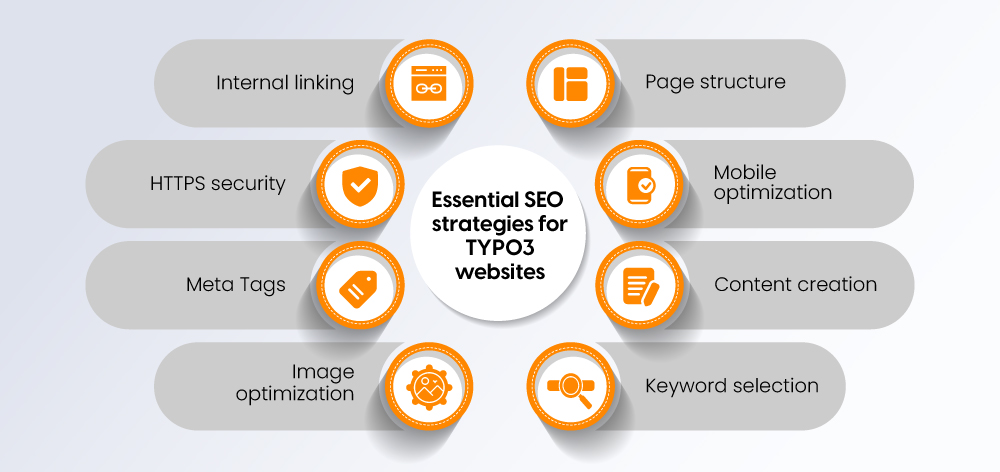
Strong search engine optimization is essential for improving the visibility of your TYPO3 website in search results. Higher rankings make your pages easier to discover, leading to more traffic and engagement. The following fundamentals help ensure your TYPO3 website is properly optimized.
### **Use Targeted Keywords**
Choose search terms your audience uses, including long-tail keywords. Place them naturally in titles, headings, and content.
Key practices:
- research relevant keywords
- use primary keywords in headings and titles
- include long-tail keywords in content
- avoid keyword stuffing
### **Create High-Quality Content**
Content should provide useful information and solve real user problems.
Focus on:
- writing clear and helpful content
- answering common questions
- using short paragraphs and subheadings
- adding bullet points for readability
### **Ensure Mobile Optimization**
Your TYPO3 website should perform well across all devices.
Important steps:
- use responsive design
- ensure fast mobile loading
- keep navigation simple
- test pages on different devices
### **Use a Clear Page Structure**
A logical structure helps both users and search engines understand your content.
Best practices:
- use one H1 heading per page
- organize content with H2 and H3 headings
- maintain clear navigation
- use readable URLs
### **Optimize Images for SEO**
To improve performance and accessibility:
- compress images
- use modern formats like WebP
- add descriptive alt text
- use relevant file names
### **Title Tags, Meta Descriptions & URLs**
Metadata helps search engines understand your page and improves click-through rates.
Important elements:
- unique title tags
- clear meta descriptions
- keyword placement in titles and URLs
- human-readable URLs
### **Use HTTPS**
Security is an important ranking factor.
Make sure to:
- install an SSL certificate
- use HTTPS across all pages
- avoid mixed content
- redirect HTTP to HTTPS
### **Optimize Internal Linking**
Internal links help search engines discover related pages.
Effective strategies:
- link to relevant pages
- use descriptive anchor text
- connect related blog posts
- strengthen important pages with internal links
Yes, TYPO3 CMS is well-suited for SEO, especially for multilingual and enterprise websites. It offers strong control over technical SEO elements such as URL routing, metadata management, and structured content.
Key advantages include:
- multilingual SEO support with hreflang
- clean and readable URLs
- scalable architecture for large websites
- structured content management for better organization
Improving your TYPO3 website’s ranking requires a combination of technical setup, optimized content, and good site structure. The following steps outline a practical workflow to help you optimize your TYPO3 website for better search visibility.
### **Step 1 – Set SEO Title and Meta Description in the TYPO3 Backend**
Start by configuring the SEO metadata for each page in the TYPO3 backend. Navigate to the **SEO tab** within the page settings and define a clear page title and meta description.
Best practices include:
- using the primary keyword in the page title
- writing a concise meta description that explains the page content
- keeping titles and descriptions unique for each page
Well-written metadata helps search engines understand your content and encourages users to click on your search result.
### **Step 2 – Configure Speaking URLs**
TYPO3 automatically generates readable URLs, known as **speaking URLs** or slugs. These URLs should clearly reflect the topic of the page.
To optimize them:
- keep URLs short and descriptive
- include relevant keywords where appropriate
- avoid unnecessary parameters or numbers
Clean URLs improve usability and help search engines understand your site structure.
### **Step 3 – Generate and Submit XML Sitemaps**
XML sitemaps help search engines discover and crawl the important pages of your website.
In TYPO3:
- enable the automatic sitemap generation
- ensure all relevant pages are included
- submit the sitemap to **Google Search Console**
This allows search engines to index new or updated pages more efficiently.
### **Step 4 – Add Schema Markup**
Structured data helps search engines better interpret your content and can enable **rich search results**.
Common schema types include:
- articles
- products
- events
- reviews
Schema markup can be implemented through [**TYPO3 templates**](https://nitsantech.de/en/blog/typo3-templates) or SEO extensions, allowing search engines to display enhanced results that improve click-through rates.
### **Step 5 – Improve Core Web Vitals**
Page performance is an important ranking factor. TYPO3 provides several ways to improve website speed and user experience.
Focus on:
- enabling TYPO3 caching
- optimizing images and using formats such as WebP
- minimizing CSS and JavaScript files
- using a CDN for faster global delivery
Better performance improves both search rankings and user satisfaction.
### **Step 6 – Build Internal Links**
Internal linking helps search engines discover related content and understand the structure of your website.
Effective strategies include:
- linking related pages and blog posts
- using descriptive anchor text
- connecting important pages through topic clusters
A strong internal linking structure improves crawlability and distributes ranking signals across your TYPO3 website.
Since TYPO3 v9, the CMS includes many built-in SEO tools that can be used directly from the backend without installing additional plugins.
These features help developers and editors manage technical SEO, optimize content, and maintain a structured website that search engines can easily understand.
#### **1. Manage meta tags**
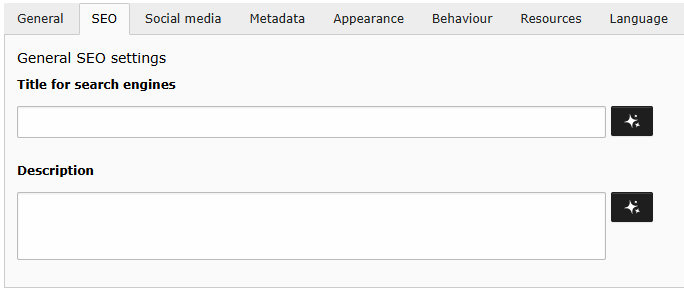
TYPO3 provides an SEO section for each page where editors can configure important metadata.
Key options include:
- Page titles and meta descriptions
- Open Graph and social media metadata
- Custom SEO fields for better search visibility
These settings help search engines understand your content and improve how your pages appear in search results and social media previews.
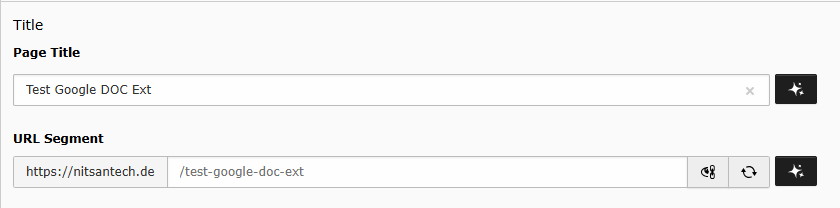
TYPO3 automatically generates readable URLs (also called **slugs**) such as:
`/services/webdesign`
Instead of complex or technical URLs. Clean URLs improve usability and help search engines understand the structure and topic of a page. Slugs can also be adjusted manually if needed.
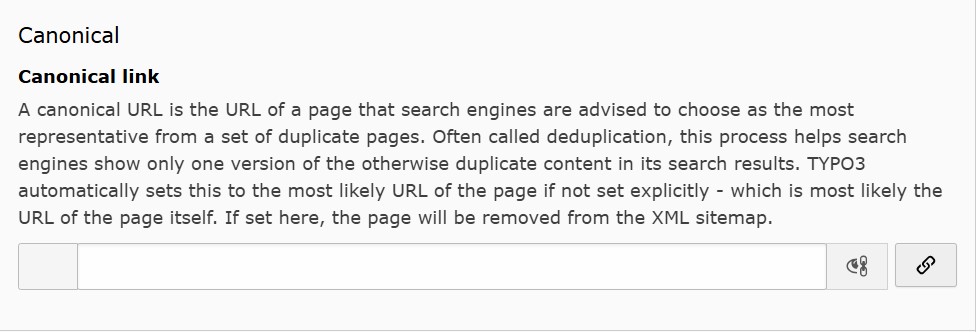
TYPO3 allows you to define a preferred **canonical URL** for each page. This helps prevent duplicate content issues when multiple URLs point to the same content.
Benefits include:
- clearer indexing for search engines
- avoiding duplicate content penalties
- stronger ranking signals for the main page version
TYPO3 automatically generates [**XML sitemaps**](https://nitsantech.de/en/typo3-glossary/typo3-xml-sitemaps), which help search engines discover and crawl your pages more efficiently.
Key features:
- automatic sitemap generation
- regular updates when content changes
- easy submission to search engines via tools like Google Search Console
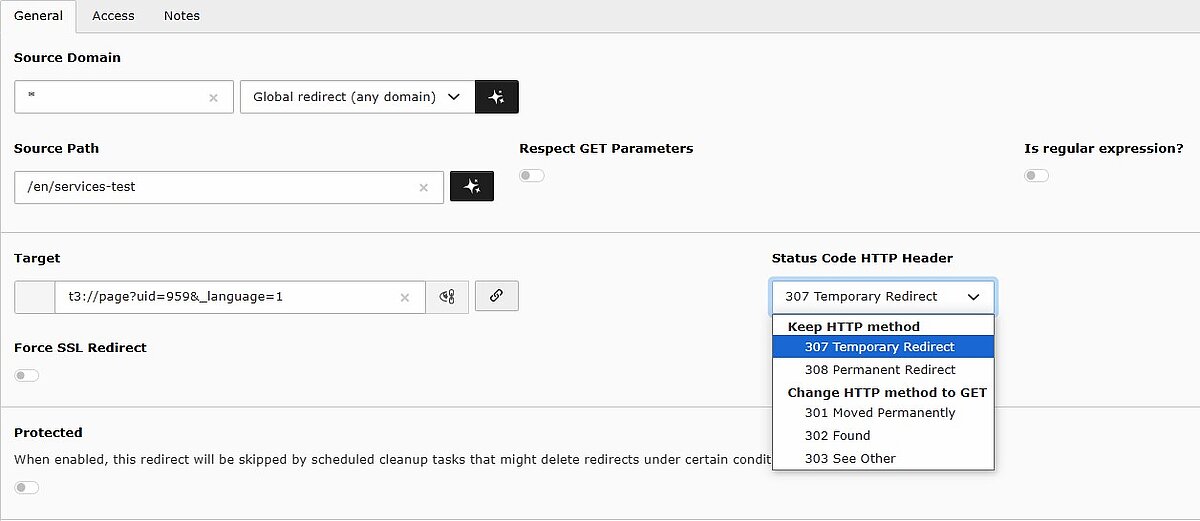
The [**TYPO3 Redirect**](https://nitsantech.de/en/blog/typo3-redirects) module makes it easy to manage URL changes.
You can create:
- [**301**](https://nitsantech.de/en/typo3-glossary/typo3-301-moved-permanently) redirects for permanent URL changes
- [**302**](https://nitsantech.de/en/typo3-glossary/typo3-redirects) redirects for temporary redirects
Redirects help preserve SEO value when pages are moved, renamed, or removed.

TYPO3 allows editors to control how search engines interact with specific pages.
Common options include:
- Setting pages to **noindex**
- Adding **nofollow** attributes
- Excluding internal or test pages from search results
This helps maintain a clean index and prevents unnecessary pages from appearing in search engines.
#### 7. Breadcrumbs (Breadcrumb Navigation)
[**Breadcrumb**](https://nitsantech.de/en/typo3-glossary/typo3-breadcrumbs) navigation is supported in TYPO3 templates and improves both usability and SEO.
Benefits include:
- clearer navigation for users
- better understanding of page hierarchy for search engines
- improved internal linking structure
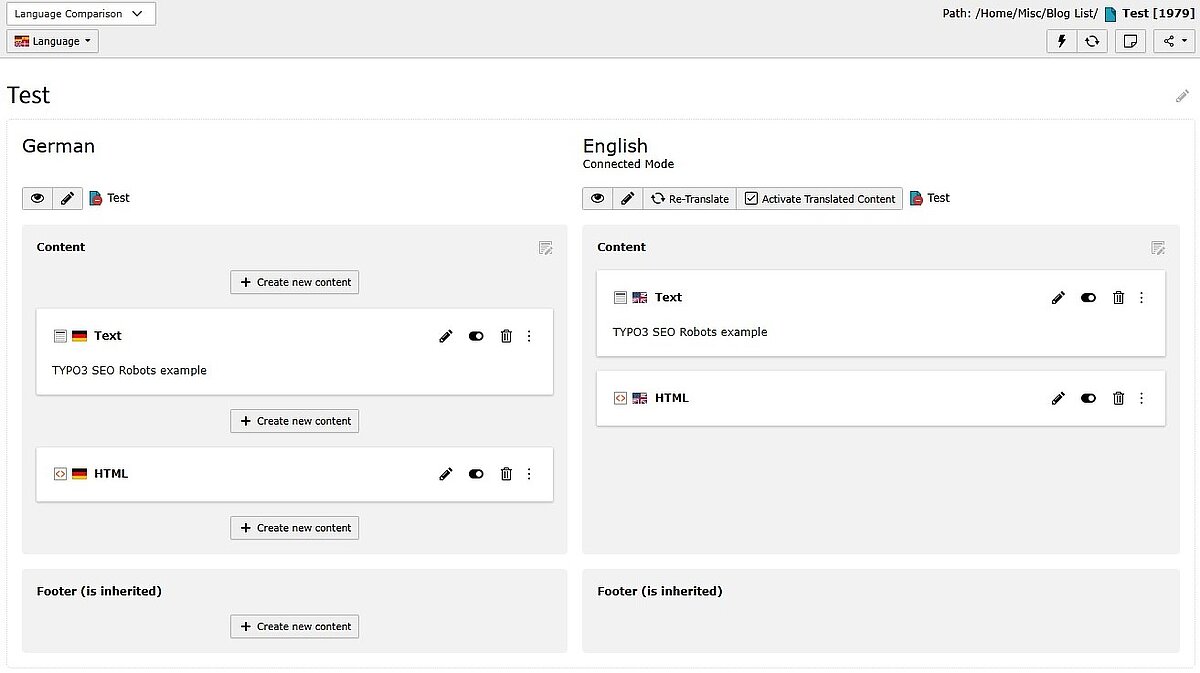
TYPO3 is widely used for multilingual websites and includes strong language management features.
With **hreflang tags**, TYPO3 ensures that:
- users see the correct language version of a page
- duplicate content between languages is avoided
- international SEO performance improves
Structured data can be implemented in TYPO3 through TYPO3 templates or extensions. This allows search engines to display [**rich snippets**](https://nitsantech.de/en/typo3-glossary/typo3-snippet-management) in search results.
Examples include:
- product information
- event details
- reviews and ratings
Rich snippets help your content stand out in search results and can improve click-through rates.
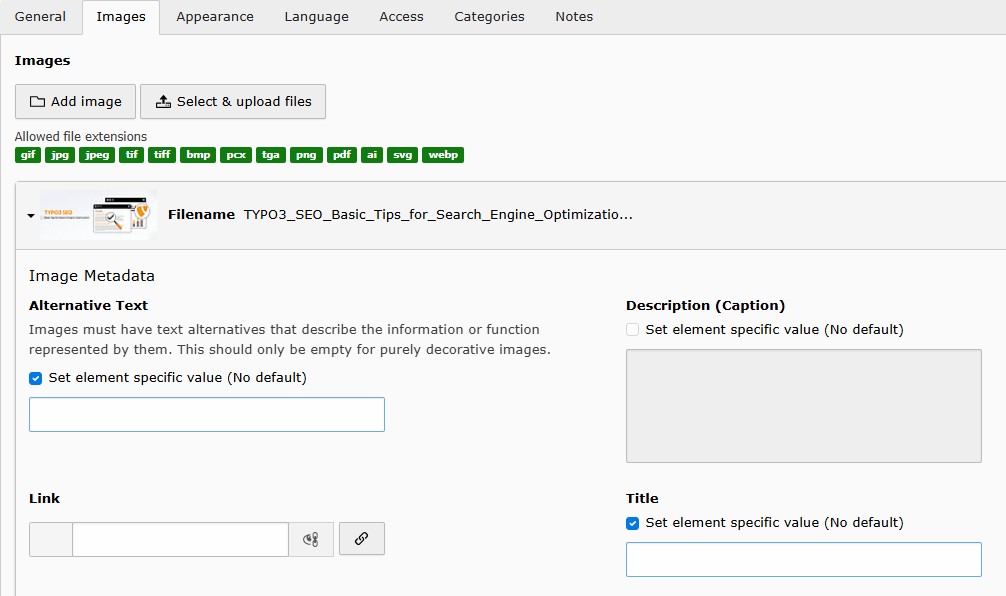
[**Alt text**](https://nitsantech.de/en/accessibility-glossary/alternative-text) describes the content of an image and helps search engines understand what the image represents.
Best practices include:
- adding descriptive alt text when uploading images
- improving accessibility for [**screen readers**](https://nitsantech.de/en/accessibility-glossary/screen-readers)
- supporting image search visibility
Tools like the [**TYPO3 Accessibility Checker**](https://nitsantech.de/en/blog/typo3-accessibility-checker) can also help improve [**accessibility**](https://nitsantech.de/en/typo3-accessibility) and ensure images are properly described for users who rely on assistive technologies.
Technical SEO plays an important role in how well your TYPO3 website performs in search engines. A proper setup helps search engines crawl, understand, and index your pages efficiently.
### **URL Routing and Slug Configuration**
Clean URLs help users and search engines understand page content.
Best practices include:
- using readable and SEO-friendly URLs
- configuring TYPO3 routing correctly
- creating meaningful slugs
- avoiding unnecessary parameters
### **Canonical Tags and Duplicate Content**
Canonical tags help prevent duplicate content when multiple URLs lead to the same page.
Key practices:
- defining canonical URLs
- preventing duplicate pages from being indexed
- ensuring search engines recognize the preferred page version
### **Robots.txt and Indexing Control**
Robots.txt controls how search engines crawl your website.
Common uses include:
- defining crawling rules
- blocking internal pages
- preventing indexing of staging environments
### **XML Sitemap Configuration**
XML sitemaps help search engines discover important pages.
Best practices include:
- enabling TYPO3 sitemap generation
- including key pages
- submitting the sitemap via Google Search Console
### **Pagination and Structured Navigation**
Clear navigation improves crawl efficiency for larger websites.
Important steps include:
- using pagination for long lists
- avoiding duplicate paginated pages
- maintaining a clear page hierarchy
Although TYPO3 includes strong built-in SEO features, extensions can further improve optimization and automate SEO tasks.
### **Yoast SEO for TYPO3**
Yoast SEO helps editors optimize content directly in the TYPO3 backend.
Key features:
- content analysis for readability and keywords
- suggestions for titles and meta descriptions
- real-time feedback while editing content
### **CS SEO Extension**
CS SEO provides additional control over technical SEO settings.
Important capabilities:
- advanced SEO configuration
- automated metadata management
- improved indexing control
### **Schema Markup Extensions**
Schema extensions help implement structured data so search engines better understand your content.
Benefits include:
- structured data for articles, products, or events
- improved visibility through rich search results
### **Redirect Management Extensions**
Redirect extensions help maintain SEO value when URLs change.
Common uses:
- managing large redirect lists
- handling complex redirect rules
- preventing broken links
A simple SEO checklist helps ensure key optimization elements are not missed.
### **Technical SEO Checklist**
- verify XML sitemaps are generated and submitted
- configure canonical URLs
- manage robots.txt rules
- maintain redirects when pages change
### **On-Page SEO Checklist**
- write optimized titles and meta descriptions
- use proper heading structure (H1, H2, H3)
- add internal links between relevant pages
### **Performance Checklist**
- optimize images
- enable TYPO3 caching
- ensure good mobile performance
### **Content Optimization Checklist**
- align keywords with search intent
- keep content updated
- maintain clear page hierarchy
Search engines evaluate websites based on performance and user experience. Improving Core Web Vitals can strengthen rankings and usability.
### **TYPO3 Caching Framework**
TYPO3’s caching system helps improve loading speed.
Best practices:
- enable page caching
- use dynamic caching strategies
- clear cache after updates
### **Image Optimization and WebP**
Optimized images improve page speed.
Key practices:
- compress images
- use modern formats like WebP
- scale images for different devices
### **Lazy Loading and Resource Optimization**
Lazy loading improves performance by loading content only when needed.
Techniques include:
- enabling lazy loading for images
- minimizing CSS and JavaScript
- reducing unnecessary scripts
### **CDN Integration for TYPO3**
CDNs deliver assets from servers closer to users.
Benefits include:
- faster global loading speeds
- reduced server load
- improved performance for large websites
### Scan TYPO3 Website for Accessibility in Seconds

High-quality content is essential for effective SEO. TYPO3 provides tools that help structure and optimize content so both users and search engines can easily understand it.
### **Structured Headings**
A clear heading structure improves readability and helps search engines interpret your content.
Best practices:
- use one **H1** for the page title
- organize content with **H2 and H3** headings
- maintain a logical content hierarchy
Headings can be assigned directly in the TYPO3 content editor.
### **Natural Keyword Placement**
Keywords help search engines understand page topics but should be used naturally.
Effective usage includes:
- placing keywords in titles and headings
- integrating them naturally in the content
- avoiding keyword stuffing
### **Keeping Content Up to Date**
Search engines favor updated and relevant content. TYPO3 provides tools that simplify content management.
Useful features include:
- scheduling content publication
- versioning for safe updates
- restoring previous content versions
### **Internal Linking**
Internal links connect related pages and help search engines discover content.
Benefits include:
- improved navigation
- stronger page relationships
- better distribution of ranking signals
TYPO3 v14 introduces several improvements that make SEO-related content editing more efficient and consistent for editors.
Key enhancements include:
- **Easier access to SEO fields**, allowing editors to manage titles, metadata, and indexing settings more quickly
- **Clearer slug management**, helping maintain clean and SEO-friendly URLs
- **Improved multilingual handling**, making it easier to manage language versions and hreflang configurations
These updates help teams maintain a consistent, search-friendly content structure across large TYPO3 websites while simplifying everyday editorial workflows.
Internal linking is an important part of SEO because it helps search engines understand your website structure and discover related pages more efficiently. A well-planned internal linking strategy also improves user navigation and distributes ranking signals across important pages.
In TYPO3, internal linking can be managed easily through the page tree and the Rich Text Editor (RTE), allowing editors to connect related pages without technical effort.
Key strategies include:
- **Optimizing the TYPO3 page tree structure** so related pages are grouped logically and easy to navigate. A clear hierarchy helps search engines understand the relationship between pages.
- **Using descriptive anchor text** when linking between pages. Anchor text should clearly describe the destination page instead of using generic phrases like “click here.”
- **Linking related articles and pages** to strengthen topic relevance. Connecting blog posts, service pages, and guides helps build stronger topical clusters.
- **Creating content hubs** that group multiple related pages under a central topic. This approach helps establish authority on important subjects and improves internal link distribution.
A strong internal linking structure improves crawlability, strengthens SEO signals across your website, and makes it easier for visitors to explore related TYPO3 content.
Even with TYPO3’s strong SEO capabilities, certain mistakes can reduce visibility.
### **Duplicate Content from Incorrect URLs**
Prevent duplicate content by:
- setting canonical tags
- maintaining consistent URL structures
- configuring routing correctly
### **Missing or Incorrect Hreflang Tags**
For multilingual sites:
- configure hreflang tags correctly
- use proper language and region codes
- keep language URLs consistent
### **Broken Redirects After Website Changes**
When URLs change:
- create **301 redirects**
- update internal links
- monitor broken links
### **Poor Slug Structure**
Good slugs should be:
- short and descriptive
- keyword-relevant
- free of unnecessary parameters
### **Missing Structured Data**
Structured data helps search engines interpret content and display rich results.
Best practices:
- implement schema markup
- add structured data for articles or products
- validate schema with testing tools
Artificial intelligence (AI) is transforming how we approach SEO, and for TYPO3 websites, it brings clear, time-saving advantages that improve performance and visibility.
### **AI-generated metadata**
AI tools can create draft meta titles and descriptions, which editors can refine and add directly to TYPO3’s SEO fields. This reduces the time needed to optimise large numbers of pages.
### **AI-assisted content optimisation**
AI can review content for clarity, relevance, and keyword coverage. Editors can apply these suggestions in TYPO3’s editor without disrupting layout or structure.
### **AI for multilingual SEO**
TYPO3 is often used on multilingual sites. AI translation tools like DeepL help to identify first translations of content and metadata, which editors can adjust before TYPO3 outputs hreflang.
### **AI-generated schema markup**
AI can generate JSON-LD patterns for articles, events, and other content types. Developers can also copy these into [**TYPO3 templates**](https://t3planet.de/en/typo3-templates) to store structured data.
### **AI-based SEO audits**
TYPO3 sites mainly employ AI to recognize common issues, such as missing metadata, slow pages, or disorganized headings. This allows teams to prioritise fixes more quickly.
Several TYPO3 Conference 2025 sessions focused on SEO improvements.
- **Structured Data and Rich Snippets**
Using JSON-LD and schema markup improves content understanding and enables rich search results.
- **Multilingual SEO Best Practices**
Proper hreflang configuration and language-aware routing improve international search visibility.
- **AI-Powered SEO in TYPO3**
AI tools can assist with metadata generation, content optimization, and translation workflows.
- **Performance and Core Web Vitals**
TYPO3 v14 improvements in caching, routing, and performance help strengthen Core Web Vitals.
- **SEO Roadmap and Future Directions**
Future [**TYPO3 updates**](https://nitsantech.de/en/blog/typo3-update) aim to improve SEO fields, structured data support, and multilingual capabilities.
The key to good search engine optimization is not easy. Whatever you do to help get out of search visibility is better than nothing if you have to keep making small improvements and not be afraid to keep improving.
TYPO3 also provides all the key building blocks to do so.
Start now and learn how to take advantage of the SEO opportunities available in TYPO3, and be consistent as you go, and everything can happen at the back of the gate.

Improve the Page Speed of Your TYPO3 Website
--------------------------------------------
Overview of key performance issues affecting TYPO3 loading times, and how to optimize for faster, more stable performance.
[ Download guide ](https://nitsantech.de/javascript:;)
**FAQs**
--------
Do I need additional TYPO3 SEO extensions?
Not necessarily. TYPO3’s core and official SEO extension cover most needs. Additional extensions can be used for specific features, but many websites perform well with built-in tools alone.
Can I set meta titles and descriptions in TYPO3?
Yes. Each page has fields in the backend where editors can add or edit meta titles and descriptions, ensuring clear representation in search results.
How does TYPO3 handle multilingual SEO?
TYPO3 supports multiple languages with automatic hreflang generation, language-aware routing, and separate metadata for each language. This ensures the correct version of a page is displayed to users and search engines.
How do I make my TYPO3 site mobile-friendly?
Use responsive templates and test across devices. TYPO3 supports modern responsive frameworks, making it easier to create layouts that work on all screen sizes
What’s new in TYPO3 v14 for SEO?
v14 improves slug generation, routing, multilingual handling, sitemap performance, backend SEO fields, and caching. These updates make SEO management more consistent and enhance Core Web Vitals.
How can AI improve TYPO3 SEO workflow?
AI can assist with generating meta titles and descriptions, optimising content, translating pages for multilingual SEO, creating structured data, and performing SEO audits, helping teams maintain higher quality and consistency.
#### Contact for Internet agency and TYPO3 projects
#### Sven Thelemann
Service Partner - Germany
[ st@nitsantech.de ](mailto:st@nitsantech.de) [ +49 351 48196661 ](tel:4935148196661)


### Sven Thelemann
Client Service Lead
- [](https://www.linkedin.com/in/sven-thelemann-0a30867b/ "linkedin")
Sven Thelemann serves as the Client Service Lead at NITSAN, focusing on delivering TYPO3 solutions that meet client goals. With a strong understanding of technology and client expectations, he ensures smooth communication and project execution. Outside of work, Sven enjoys cycling and experimenting with homemade recipes.
Comments and Responses
----------------------
Thank you for your comment. Your Comment Added Successfully.
Thank you for your comment. Your Comment Will Be Visible After Approval.
Oops! Something went wrong, please try again later.
##### **Be the First to Comment**
### Related Blogs
[ 
#### TYPO3 CMS for Public Sector Websites: Requirements and Best Practices
](https://nitsantech.de/en/typo3-public-sector-2026)
[ 
#### TYPO3 Backup and Restore: Manual and Automated Backup Steps
](https://nitsantech.de/en/blog/typo3-backup)