---
title: "BITV 2.0 and WCAG: Germany’s Web Accessibility Law Explained"
url: "https://nitsantech.de/en/blog/bitv-and-wcag"
description: "Confused about BITV 2.0 and how it differs from WCAG? This guide breaks down Germany’s web accessibility law and how to stay legally compliant."
image: "https://nitsantech.de/fileadmin/_processed_/c/8/csm_BITV_2.0_vs_WCAG_68ea988691.jpg"
date: 2025-07-30
modified: 2026-02-24
lastUpdated: 2026-02-25
keywords:
- BITV 2.0 and WCAG
- BITV
- WCAG
categories:
- Barrierefreiheit
---
# BITV 2.0 and WCAG: Germany’s Web Accessibility Law Explained
BITV 2.0 and WCAG: Germany’s Web Accessibility Law Explained
============================================================
30 Jul 2025
[](https://nitsantech.de/en/blog/author/stefan-reinhardt)
[Stefan Reinhardt](https://nitsantech.de/en/blog/author/stefan-reinhardt)
[ Accessibility ](https://nitsantech.de/en/categories/barrierefreiheit)
Accessibility is not a recent concept. Its significance is widely acknowledged.
Table of content
What is frequently unclear is the way accessibility is practiced in Germany. BITV 2.0 is not a set of recommendations or guidelines. It is a legal standard that is based on WCAG but implemented through German jurisprudence.
WCAG and BITV 2.0 are interlinked but they are different:
- WCAG indicates how to obtain accessibility
- BITV 2.0 indicates who has to follow, what is required, and how compliance is monitored
This differentiation is crucial for public institutions, companies, and non-profits that work in regulated environments.
The following are the main points of the article:
- How BITV 2.0 is different from WCAG
- What the law requires in Germany
- Who is required to comply now and who will be the next to be affected
No theory. Just the facts that are necessary to evaluate compliance and responsibility.
[**BITV 2.0**](https://www.gesetze-im-internet.de/bitv_2_0/BJNR184300011.html) (*Barrierefreie-Informationstechnik-Verordnung*) is the German law governing digital accessibility, which is legally binding. It specifies the requirements for designing websites, mobile apps, and digital documents in such a way that people with disabilities can access them easily.
BITV 2.0 stipulates [**WCAG 2.1**](https://www.w3.org/WAI/WCAG21/Understanding/intro) **Level AA** as its base standard. The technical specifications are derived from WCAG, but BITV 2.0 legalizes them as obligations under German law. Moreover, it introduces a formal dimension to the law with requirements like accessibility statements and feedback systems.
The regulation is based on the **Disability Equality Act (**[**BGG**](https://www.gesetze-im-internet.de/bgg/)**)** and is applicable to the public sector only, which includes ministries, local governments, and universities, as well as other public institutions.
However, the rule for private companies has become less strict.
The **Accessibility Reinforcement Act** (BFSG) has made the accessibility requirements applicable to many digital services targeting consumers in 2025 and onwards, especially in the banking, e-commerce, and transport sectors.
BITV 2.0 is legally binding in Germany, but its scope is clearly defined.
### **Public bodies are required to comply.**
The compliance of the authorities at federal, state, and local levels is included in this requirement, along with the institutions governed by public law. Ministries, city governments, universities, and public sector institutions are the most common examples.
The BITV 2.0 regulations should be followed for their websites, mobile apps, and digital documents.
### **Organisations performing public tasks may also be covered.**
An organisation can be considered a performing public task if it acts on behalf of a public body or receives public funding, and its legal role and responsibilities will determine whether or not accessibility obligations apply to it.
### **Private companies are increasingly affected through related legislation.**
The BITV 2.0 still focuses on public institutions, while the Accessibility Reinforcement Act adds that from 2025, private sectors providing services like e-commerce, banking, transport, and digital consumer services will also be covered under the new accessibility requirements.
In Germany, organizations' accessibility obligations vary according to their legal status, the scope of services offered, and the sector in which they operate. It is very important to clarify this at an early stage before considering any technical or organizational measures.
The [**WCAG**](https://nitsantech.de/en/accessibility-glossary/wcag) ***(Web Content Accessibility Guidelines)*** is the globally recognized technical standard for accessible digital services. It specifies the requirements of accessibility for websites, apps, and digital content for people with disabilities.
W3C or the World Wide Web Consortium is the organization behind the development of WCAG, and the standard is considered as the technical groundwork of accessibility laws around the globe, including Germany.
Presently, the most relevant versions are the WCAG 2.0 and WCAG 2.1, which are built around four key principles ("*POUR*"):
- **Perceivable:** Nothing should stop users from seeing, hearing, or receiving alternative presentations of the content
- **Operable:** The interface should be accessible through keyboard and assistive technology
- **Understandable:** The information and the user interaction should be simple and predictable
- **Robust:** The content should be equally good and usable on all browsers, devices, and assistive software
There are three conformity levels in the WCAG:
- **Level A** - Minimum requirements for accessibility
- **Level AA** - The legally accepted standard in Germany
- **Level AAA** - Accessibility greatly improved but not required by law
For Germany, **WCAG 2.1 Level AA** is the practical and legal standard.
It is the level of accessibility that includes the users; at the same time, it does not go further than what is reasonable. This is the level that is cited by BITV 2.0 and associated regulations.
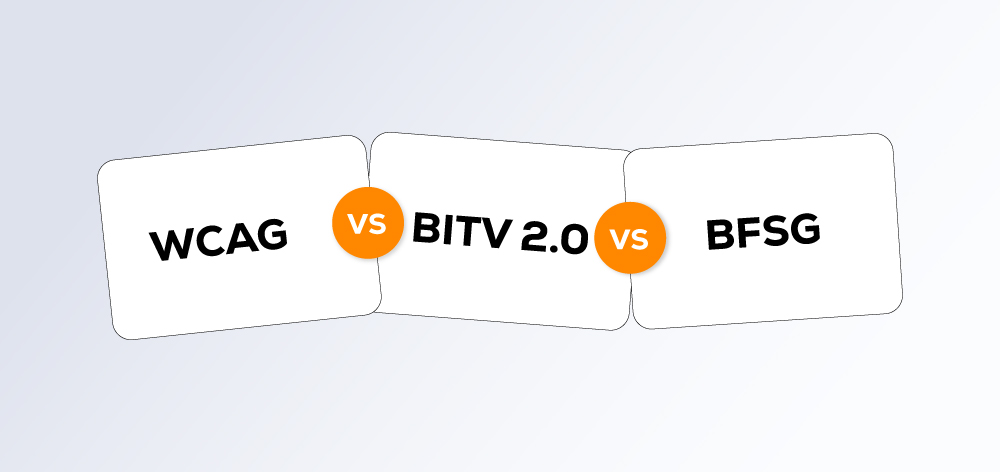
A side‑by‑side view of WCAG, BITV 2.0, and the BFSG helps clarify how global guidelines, German public‑sector rules, and the 2025 private‑sector law fit together, who must do what, by when, and on which technical baseline.
| **Aspect** | **WCAG** | **BITV 2.0** | **BFSG** |
|---|---|---|---|
| Purpose | Technical accessibility guidelines | German regulation implementing accessibility | German law extending accessibility to the private sector |
| Origin | Developed by the W3C (international standard) | German ordinance under the Disability Equality Act (BGG) | German federal law |
| Legal status | Not a law | Legally binding in Germany | Legally binding in Germany |
| Primary role | Defines **how** accessibility is achieved | Defines **who must comply** in the public sector | Defines **who must comply** in the private sector |
| Technical basis | WCAG success criteria | WCAG 2.1 Level AA | WCAG-based requirements |
| Structure | 4 principles (POUR), guidelines, success criteria | Based on WCAG, structured by mandatory and recommended priorities | Refers to accessibility requirements for defined services |
| Conformance levels | A, AA, AAA | WCAG 2.1 Level AA as legal minimum | WCAG-based requirements depending on service type |
| Declaration of accessibility | Not required | Mandatory for public-sector websites and apps | Required under applicable consumer regulations |
| Feedback mechanism | Not part of the standard | Mandatory under BITV 2.0 and EU Directive 2016/2102 | Required as part of consumer protection |
| Simple / easy language | Not explicitly required | Strongly recommended, especially for cognitive accessibility | Relevant depending on service scope |
| Scope of application | Global best practice | Public bodies and public-law institutions | Private companies offering consumer-facing digital services |
| Enforcement | No direct enforcement | Monitored by federal and state authorities | Enforced via market surveillance and consumer protection |
| Effective timeline | Ongoing standard | In force | Applies from 2025 |
**Practical interpretation:**
WCAG defines the technical accessibility standards. BITV 2.0 and BFSG translate these standards into legally enforceable obligations in Germany, depending on whether an organisation operates in the public or private sector.
Accessibility compliance under BITV 2.0 is monitored and documented in a formal way. Websites and apps in the public sector are subjected to the reviews of assigned monitoring bodies at the federal and state levels.
This process is based on the [EU Directive 2016/2102](https://eur-lex.europa.eu/eli/dir/2016/2102/oj/eng), which mandates that the accessibility status of public digital services be reported periodically.
**How audits are conducted**
The compliance verification process consists of a multi-layered method:
- **Automated testing:** This is the method used to spot technical problems like absence of alternative texts, contrast mistakes, or wrong HTML structure.
- **Manual testing:** This step is crucial to evaluate keyboard navigation, focus handling, form usability, and logical content order, where automation cannot give reliable results.
- **User-based testing:** In many cases, the evaluation includes individuals with disabilities to ascertain the usability from a real-life perspective and also to point out the barriers that exist in practice.
#### **What are the criteria for evaluation?**
All the checks are performed with respect to the WCAG 2.1 Level AA standard which is the legal standard required by BITV 2.0.
Exclusively using automated tools is not sufficient. Manual validation documented is a necessity to prove compliance.
### **How Accessibility Is Enforced and Monitored in Germany**
Accessibility Compliance under BITV 2.0 is not only based on self-declaration. Monitoring in Germany is ongoing when it comes to compliance.
The public sector's websites and applications go through the monitoring procedures regularly and these procedures are coordinated at both federal and state levels. The reviews are aligned with EU Directive 2016/2102 and are done according to a specified evaluation framework.
**Monitoring usually comprises:**
- Automated testing as a means of discovering technological flaws
- Manual reviews focusing on evaluating the hierarchy, navigation, and overall experience
- User-based testing where disabled individuals are often engaged
Every single review measures adherence to WCAG 2.1 Level AA, which is the standard required by BITV 2.0.
The situation gets documented and the report is issued. In case of discovering accessibility issues, these will have to be fixed by the concerned organization in a reasonable period of time.
The outcome of monitoring might also affect the necessity of future audits or the use of formal procedures. Thus, for the public sector, accessibility is not a one-off job but a continuous duty that needs to be recorded and preserved for the long run.
In case your website or application does not fulfill the requirements, the organization has to face the following possible consequences:
- **User feedback:** Every person can file a complaint through the feedback system - and the organization must reply.
- **Legal action:** If the matter is not settled, it might go to an arbitration institution or a regulatory authority.
- **Public disclosure:** The accessibility statement has to be easily accessible to the public and current. Thus, the absence of accessibility is known by everyone - even the monitoring bodies.
- **Damage to reputation:** The inaccessibility of public institutions implies that certain citizens are not taken into consideration. It is a source of losing trust and reputation for companies.
- **User complaints and feedback procedures:** Any individual can notify about accessibility hindrances through the compulsion feedback mechanism. Organizations are obliged to reply within the set time intervals.
- **Formal review and escalation:** If difficulties still exist, the issue can be taken to arbitration or supervisory bodies. These authorities might then start another round of review or enforcement.
- **Public visibility of non-compliance:** Accessibility statements have to be made public and regularly updated. The users, the monitoring bodies, and the oversight authorities can see the identified accessibility gaps.
- **Reputational and trust impact:** Accessibility issues for public entities create a public trust deficit and inclusiveness perception. For private companies, the issues could lead to loss of credibility, customer confidence, and legal certainty.
BITV 2.0 compliance is not achieved through a single check. It requires structured testing, clear documentation, and ongoing responsibility.
### **1. Carry out accessibility testing**
Initially, conduct a mixture of automated and manual testing.
- Leverage tools like [**TYPO3 Accessibility Checker**](https://nitsantech.de/en/blog/typo3-accessibility-checker) to spot the tech problems.
- Manually validate the results to examine keyboard use, focus order, and usability.
- When possible, involve real users to find out practical hindrances.
Though automated tools assist the process, they still cannot substitute for manual validation.
### Scan TYPO3 Website for Accessibility in Seconds

### 2. Prioritize fixing the issues preventing access first
Concentrate on the problems that limit users to the core functions and content, like:
- Absence or wrong alternative texts
- Low colour contrast
- Keyboard traps
- Confusing or broken navigation
If the users can't access vital content, the compliance is not met.
### **3. Make a public accessibility statement**
BITV 2.0 calls for a public accessibility statement.
This must indicate the following points clearly:
- Present compliance state
- Barriers known
- Contact and feedback options
The statement has to be updated regularly.
### **4. Allow user feedback**
Feedback mechanism is a must. Users should have a hassle-free way to report barriers.
Not responding or acting on the feedback could result in formal complaints or escalation.
### **5. Accessibility must be embedded into the daily workflows**
Accessibility should be part of:
- Design choices
- Content creation
- Dev and QA
Train personnel and document responsibilities to secure long-term compliance, not just one-time fixes.
WCAG defines the **technical accessibility criteria**. It explains how digital content must be built so it can be used by people with disabilities. On its own, WCAG is **not a law**.
BITV 2.0 is the **legal framework in Germany** that makes WCAG requirements mandatory for defined organisations. It adds formal duties such as accessibility statements, feedback mechanisms, and documented compliance.
### **What this means for organisations in Germany**
- Following WCAG is **necessary**, but **not sufficient,** for legal compliance
- BITV 2.0 determines **whether compliance is mandatory**, **how it is assessed**, and **what happens if gaps exist**
- Legal responsibility depends on:
- Organisational role
- Sector (public or private)
- Type of digital service offered
**In short,** WCAG explains *how* to build accessible systems. BITV 2.0 defines *who must comply* and *how accessibility is enforced* in Germany.
BITV 2.0 and WCAG 2.1 pursue a common goal: to make digital services accessible to everyone.
But this is not just about ticking off a legal checklist. It's about creating digital systems that include and respect all people - regardless of their abilities.
By understanding how BITV builds on WCAG, you can ensure that your implementation goes beyond the legal minimum. The goal is to create digital environments that are functional, inclusive and future-proof.
Accessibility is not an additional task. It is simply good work.
Start with an accessibility audit. Learn more about BITV 2.0 and your responsibilities, and get your team involved. If you don't know where to start, our [**TYPO3 Agency**](https://nitsantech.de/en/typo3-agency) - **NITSAN** will be happy to advise you.
For more practical tips and insights around digital accessibility and legal requirements, visit our blog: **Accessible Website With** [**TYPO3 Accessibility**](https://nitsantech.de/en/blog/typo3-accessibility)**!**
FAQs
----
Is WCAG compliance enough to meet BITV 2.0 requirements?
No. WCAG defines the technical accessibility criteria, but BITV 2.0 adds legal obligations. These include accessibility statements, feedback mechanisms, and formal monitoring. WCAG compliance is necessary, but it does not automatically mean legal compliance in Germany.
Who must comply with BITV 2.0 in Germany?
BITV 2.0 applies primarily to public bodies, such as ministries, municipalities, universities, and public institutions. Organisations performing public tasks may also be affected, depending on their legal role and responsibilities.
Does BITV 2.0 apply to private companies?
Indirectly, yes. While BITV 2.0 targets public bodies, private companies are affected through the Accessibility Reinforcement Act (BFSG). From 2025, many consumer-facing digital services must meet accessibility requirements.
What accessibility standard is legally required in Germany?
The legal benchmark is **WCAG 2.1 Level AA**. This level is referenced by BITV 2.0 and related German and EU regulations. Level AAA is not generally required by law.
How is BITV 2.0 compliance checked?
Compliance is monitored through automated testing, manual audits, and user-based testing. Reviews are coordinated by federal and state monitoring bodies and assess conformance with WCAG 2.1 Level AA.
What happens if a website is not BITV 2.0 compliant?
Users can submit formal complaints through mandatory feedback mechanisms. Unresolved issues may lead to arbitration or supervisory review. Non-compliance is publicly visible and can affect legal certainty and trust.

#### Contact for SMEs, government organizations and BITV 2.0
#### Stefan Reinhardt
Service Partner - Germany
[ stefan.reinhardt@nitsantech.de ](mailto:stefan.reinhardt@nitsantech.de) [ +49 6204 6011377 ](tel:4962046011377)

### Stefan Reinhardt
Service Partner
- [](https://www.linkedin.com/in/markt-machen-system/ "linkedin")
Stefan solves tech problems for businesses. He focuses on upgrading outdated systems and moving companies to the cloud. At NITSAN, he collaborates with clients to create solutions that save both time and money. Outside of work, he enjoys brewing coffee and hiking with his dog.
Comments and Responses
----------------------
Thank you for your comment. Your Comment Added Successfully.
Thank you for your comment. Your Comment Will Be Visible After Approval.
Oops! Something went wrong, please try again later.
##### **Be the First to Comment**
### Related Blogs
[ 
#### Accessibility websites with TYPO3 | WCAG, BFSG & BITV 2.0
](https://nitsantech.de/en/blog/typo3-accessibility)
[ 
#### TYPO3 Accessibility Checker | Improving Web Accessibility
](https://nitsantech.de/en/blog/typo3-accessibility-checker)